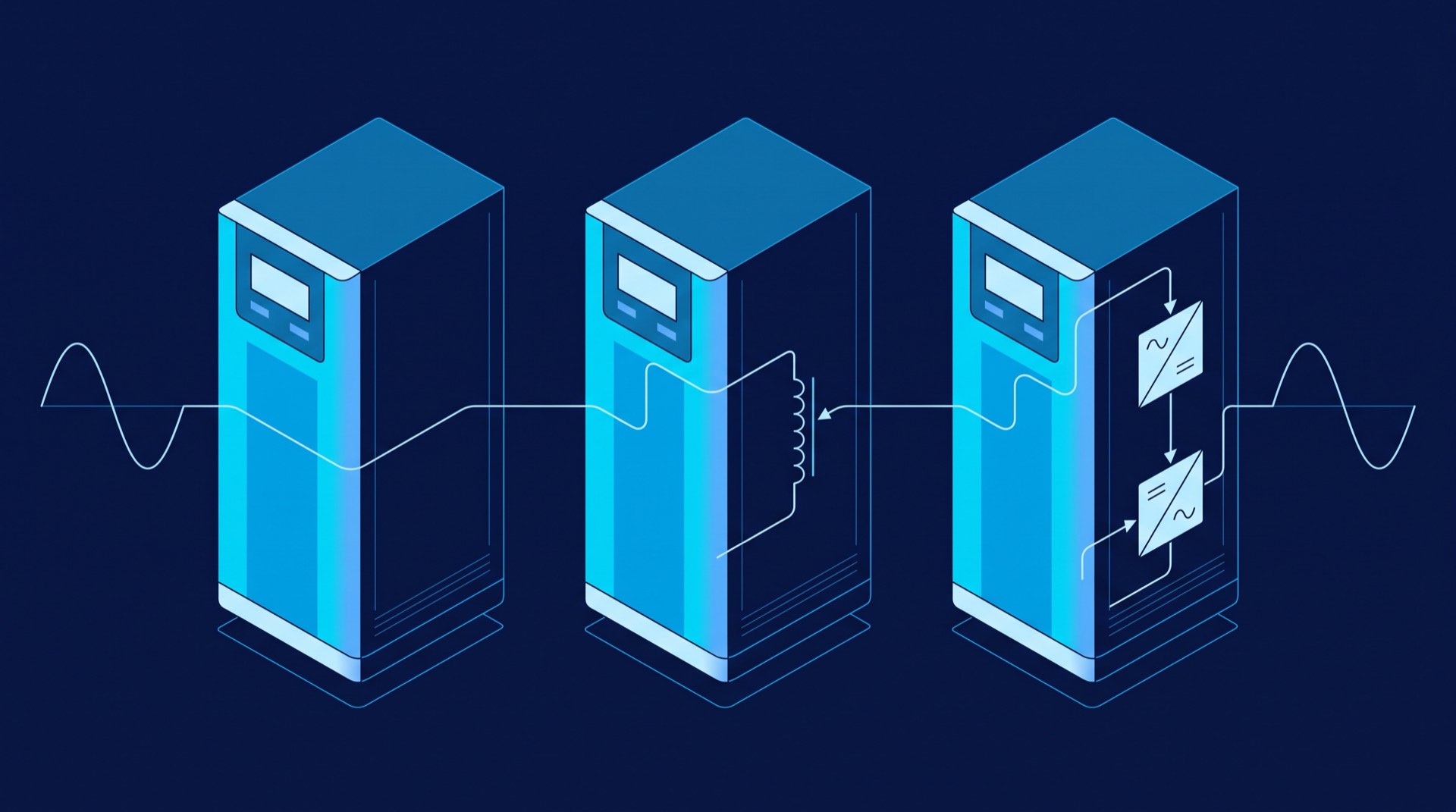
The three UPS topologies, and what each one does to the waveform
Every UPS sits between a supply you do not control and a load you cannot afford to lose. What separates the topologies is not how they behave during an outage — they all close the gap with a battery — but how much of the incoming waveform reaches the load the rest of the time, which is to say during almost the whole of the equipment’s service life. Outage behaviour is the part every specification covers; steady-state behaviour is the part that decides whether a load is genuinely protected or merely backed up.
- Offline / standby
- The load is wired straight to the mains. The inverter sits idle keeping the battery charged, and takes over only once the input leaves a permitted window. Between events, whatever the utility delivers — sags, notches, harmonic distortion, frequency wander — arrives unaltered. It is the cheapest arrangement and does nothing for power quality, so it suits only loads whose real risk is total loss of supply.
- Line-interactive
- The load is still fed from the mains, but through a tap-switched autotransformer under microprocessor control. That gives the unit Automatic Voltage Regulation: it can pull a sustained brownout up or push a sustained overvoltage down without discharging the battery at all. The inverter is bidirectional and doubles as the charger. Frequency and waveform shape, however, still pass through largely as they arrive. The E-LN Series line-interactive UPS works this way.
- Online double conversion
- The input is rectified to DC, and the output is synthesized from that DC by an inverter that never stops running. The mains becomes a source of energy rather than a source of waveform. Voltage, frequency and waveform shape are all regenerated instead of filtered, so input disturbances are decoupled from the output rather than merely attenuated. The EON 11 Series online UPS and the rack and tower convertible EON RT 11 Series are double-conversion families.
What a line-interactive UPS corrects, and what it passes through
AVR is the reason line-interactive units earn their keep on weak supplies and long cable runs. The E-LN Series accepts an input from 162 to 295 VAC and corrects it with a two-step boost and AVR arrangement, so a site that spends every afternoon at the bottom of its voltage tolerance stops cycling its battery each time the voltage dips. Battery cycling is the dominant wear mechanism in a small UPS, and a unit that regulates without discharging will outlast one that discharges to solve the same problem.
What AVR cannot do needs stating plainly, because this is where specification arguments actually happen.
- Frequency is passed through. The E-LN output is quoted at 50/60 Hz ±1 Hz, tracking the source — fine in normal service, but nothing is held for you if the supply itself drifts.
- The output is a simulated sine wave, not a regenerated one. Most switch-mode supplies are indifferent to this; transformer-input equipment, some motor loads and certain instrumentation are not.
- There is a real break at transfer. The E-LN transfer time is quoted as under 8-10 ms.
- Output regulation on battery is ±10%, against the ±1% that the double-conversion families hold continuously.
- Output power factor is 0.6, which changes the sizing arithmetic more than most buyers expect — see below.
What online double conversion actually buys you
Because a double-conversion inverter is always the source, the specifications it can hold are of a different order. The EON 11 Series regulates its output to ±1%, delivers a full sine wave, and quotes harmonic distortion of ≤2% on linear loads; on non-linear loads the datasheet quotes ≤4% and ≤5% depending on the model. Crest factor is 3:1 — the figure that matters when the load is a bank of switch-mode supplies drawing short, tall current pulses rather than a smooth sinusoid.
The transfer behaviour is the headline. Battery-to-inverter transfer is quoted at 0 ms, not because the electronics are impossibly fast but because there is no transfer to make: the inverter was already carrying the load and simply changes where its DC comes from. Inverter-to-bypass is quoted at under 4 ms.
The input side is decoupled too. The series accepts 185-275 VAC at 100% load and 120-185 VAC at 50% load, tolerates an input frequency range of 40-70 Hz, and applies input power factor correction so the UPS presents a near-unity load to the feeder upstream. Overload capability is 1 minute at 105-125% load and 30 seconds at 125-150%, so inrush need not become a shutdown.
- Note the narrower input window
- At full load the EON 11 accepts 185-275 VAC, where the E-LN accepts 162 to 295 VAC. A double-conversion unit holds a very tight output to the edge of its window and then goes to battery; a line-interactive unit rides a wider window with a looser output. On a chronically low supply the online machine may cycle its battery where the line-interactive one would not. That is a real engineering trade, and it is why the supply survey comes before the topology choice.
Transfer time versus what your load can actually ride through
The comparison that decides most cases is under 8-10 ms against 0 ms. Whether that difference matters is a property of the load, not of the UPS, and no UPS brochure can answer it: the figure you need is the load’s own hold-up or ride-through specification, taken from its datasheet.
A transfer is also not simply a gap. It is a discontinuity — the load rides on its internal energy storage for a few milliseconds, then reconnects at whatever point of the cycle the switching lands on. Equipment that tolerates the gap can still object to the step. These are the failure modes worth checking before accepting a transfer-based topology.
- Contactor and relay coils in the load path, which drop out and do not pick back up without a command.
- Drives, PLCs and controllers that latch an undervoltage fault and need a manual or sequenced restart, turning a millisecond event into an hour of downtime.
- Loads already running at the limit of their own supply, where the ride-through margin is spent.
- Processes with a defined start-up order, where one device dropping out of step is worse than the line stopping.
- Cases where the transfer can coincide with a generator changeover downstream, so two discontinuities stack.
Why kVA is the wrong number to compare
The single most expensive mistake in this decision is comparing nameplate kVA across topologies. Output power factor makes those numbers non-equivalent.
The E-LN2000 is rated 2000VA and 1200W. The 2 kVA member of the EON 11 Series is rated 2000VA and 1800W. Same headline figure, 600 W apart in usable output, because output power factor is 0.6 in the first case and 0.9 in the second. Specify by watts and by the load’s own power factor, and the comparison becomes honest.
Crest factor belongs in the same conversation. A load made of switch-mode supplies draws current in narrow peaks, and the UPS has to deliver those peaks without clipping or derating. The EON 11 Series quotes 3:1; the line-interactive datasheet quotes a simulated sine wave and no distortion figure at all, which is itself informative.
The published ranges also settle part of the question. The E-LN Series spans 650VA to 2000VA and the EON 11 Series spans 1kVA to 10kVA, so there is only a narrow band where both are candidates; above roughly 2 kVA in the commercial UPS range the choice has effectively been made for you.
When a line-interactive UPS is the right answer
A guide that concludes buy the most expensive option is not a guide. Line-interactive is the correct specification for a large share of real loads, and choosing double conversion for them buys heat and capital cost rather than availability.
It fits where the load tolerates a short transfer, the supply is broadly sane but drifts in voltage, and the unit has to live in a space with no cooling budget and people sitting next to it: workstations and office PCs, small servers, point-of-sale and CCTV recorders, network edge equipment, elevator control gear — the E-LN Series carries an elevator saver designation for exactly that duty.
The operating advantages are structural. A line-interactive unit is not running a full rectifier and inverter chain continuously, so it converts less energy and rejects less heat into the room. The E-LN is quoted at under 45 dB at one metre against under 50 dB for the EON 11 — the difference between a unit you can put under a desk and one you would rather not. Recharge is 6-8 hours to 90% capacity and battery voltage is 12-24VDC, so replacement cells are a commodity rather than a project.
Where double conversion earns its cost and its heat
Double conversion is worth paying for when at least one of the following is a requirement rather than a preference: the load cannot see a break or a step at all; frequency independence matters, because an input range of 40-70 Hz with a regenerated 50/60 Hz output is what lets a load ride out generator hunting, and the EON 11 Series lists genset suitability among its technical highlights for that reason; the site needs actual frequency conversion between 50 and 60 Hz, available on the series at a 60% de-rate; or the load is heavily non-linear, so the ≤2% linear distortion figure and the 3:1 crest factor are doing real work.
There is one caveat that catches buyers who have already paid for double conversion. ECO mode recovers most of the efficiency gap — the EON 11 Series is published at up to 92% in line mode and 97% in ECO mode — but it does so by feeding the load from the mains and reverting to a transfer, quoted at 10 ms. You can have seamless transfer or you can have the ECO-mode efficiency, and on any given day you are running one or the other. Decide which the site needs, write it into the commissioning documents, and check the mode setting at handover.
One sizing detail gets missed: the series is specified for 0-1000 m altitude, with a 1% power loss for each additional 100 m. On a high site that derate belongs in the sizing calculation.
Online vs line-interactive UPS: how to settle it for your load
Work in this order and the topology decision falls out of the evidence rather than the budget.
- Write down the load’s real watts, power factor and crest factor — not its VA, and not the label rating.
- Get the ride-through tolerance from the load’s own datasheet. It is the single figure that decides whether a transfer-based topology is admissible.
- Survey the supply: steady-state voltage window across a working week, frequency stability, and whether a generator is in the chain.
- Decide explicitly whether frequency independence is a requirement or a preference, and record the answer.
- Account for the heat and the noise where the unit will physically sit, not where the drawing puts it.
- Only then choose the topology, and only then a rating — sized in watts, with any altitude derate applied.
- Check the range boundaries first: the commercial line-interactive and double-conversion families overlap over a narrow band only.
- When the question stops being about topology
- Above the single-phase commercial band, or wherever a unit has to be maintained without dropping the load, the decision moves from topology to architecture — the territory of hot-swap modular UPS systems and their redundancy and serviceability arguments. On a plant floor, a vessel or an oil and gas site, environmental ruggedness and fault tolerance outrank waveform quality; that is what the rugged industrial UPS range is built for. Topology is the right first question for commercial loads, but rarely the last one.