Insights and Guides
Practical guidance on specifying, sizing and maintaining critical power equipment, from the engineers who build and support it.
 Selection Guides
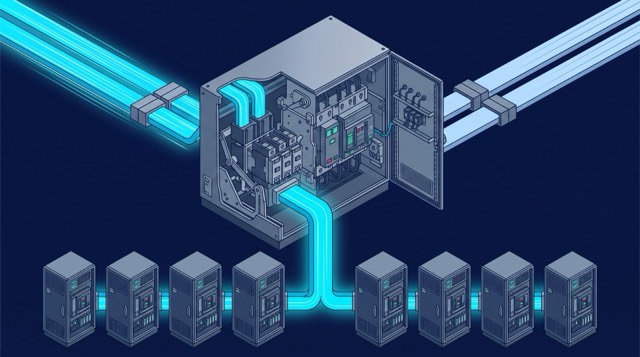
ATS vs STS: Choosing the Right Transfer Switch
An automatic transfer switch and a static transfer switch both move a load between two supplies, but only one of them does it without the load going dark. Here is how to tell which your design actually needs. Sector Applications
The Datacenter Power Chain, From Grid to Rack
Every stage of a datacenter power chain fails in its own way, and only one of them can bridge a loss of supply with no interruption at all. A stage-by-stage walk from the utility transformer to the rack PDU, with the failure modes and the redundancy that answers each one.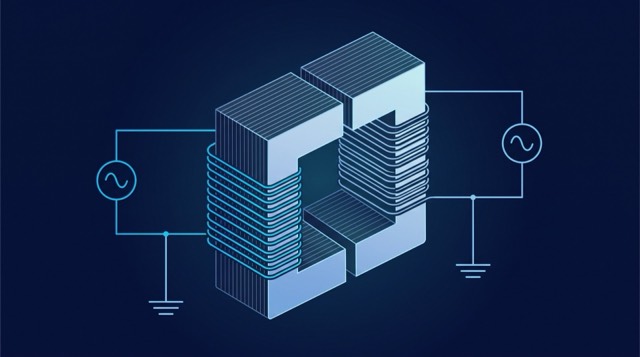 Technology Explained
Galvanic Isolation in UPS Systems, and Why Industrial Sites Need It
Galvanic isolation puts a transformer winding between a UPS input and its output so that no conductive path remains between them. Here is what that buys on an industrial site, why many modern UPS designs deliberately leave it out, and how to confirm which paths in a machine are actually isolated. Technology Explained
Harmonic Distortion and Why the Rectifier Front End Matters
The rectifier is the part of a UPS or converter that faces the supply, and its design decides what the installation does to the upstream network. What input current harmonics are, what they cost in transformer heating, neutral current and generator instability, and how to specify a front end so competing quotes describe the same machine.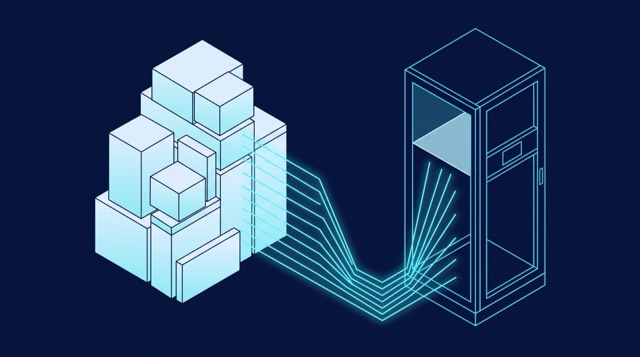 Selection Guides
How to Size a UPS: Load, Power Factor and Headroom
A repeatable method for sizing an uninterruptible power supply: load inventory first, then kVA against kW, then inrush and derating, then runtime as its own calculation — with the real cost of oversizing and the information a supplier needs to quote. Sector Applications
Industrial UPS Systems for Power Plants and Heavy Industry
A plant is not a datacenter, and specifying datacenter-shaped equipment for one is the usual mistake. What genuinely differs — the environment, the mixed AC and DC load, the electrical context, galvanic isolation and a service life measured in decades — and how to specify around it. Sector Applications
Marine Frequency Converters and Shore Power Connection
A 60 Hz vessel berthing at a 50 Hz quay has a mismatch that only equipment can resolve. Where the converter belongs, what it must deliver besides frequency, and what to settle before an order.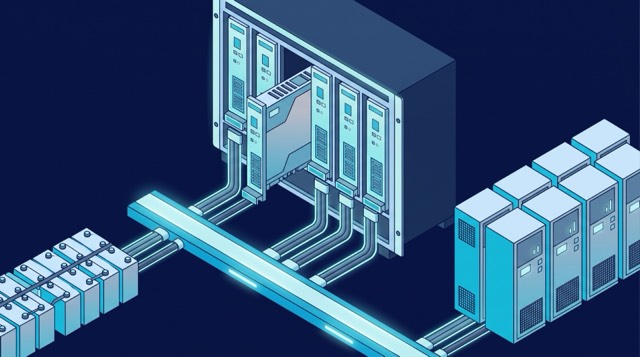 Selection Guides
Modular DC Rectifier Systems: Sizing and Redundancy
A DC power plant is not an AC UPS with the inverter deleted, and it is not sized like one. Here is the method: amps at the bus voltage you will actually hold, plus the battery recharge current almost every enquiry forgets, then redundancy counted in whole modules.NEED SOMETHING SPECIFIC
Can't Find Exactly WhatYou Are Looking For?
Our engineering team specialises in bespoke power solutions. Share your requirements and we'll design a system built precisely for your application.