What galvanic isolation actually means in a UPS
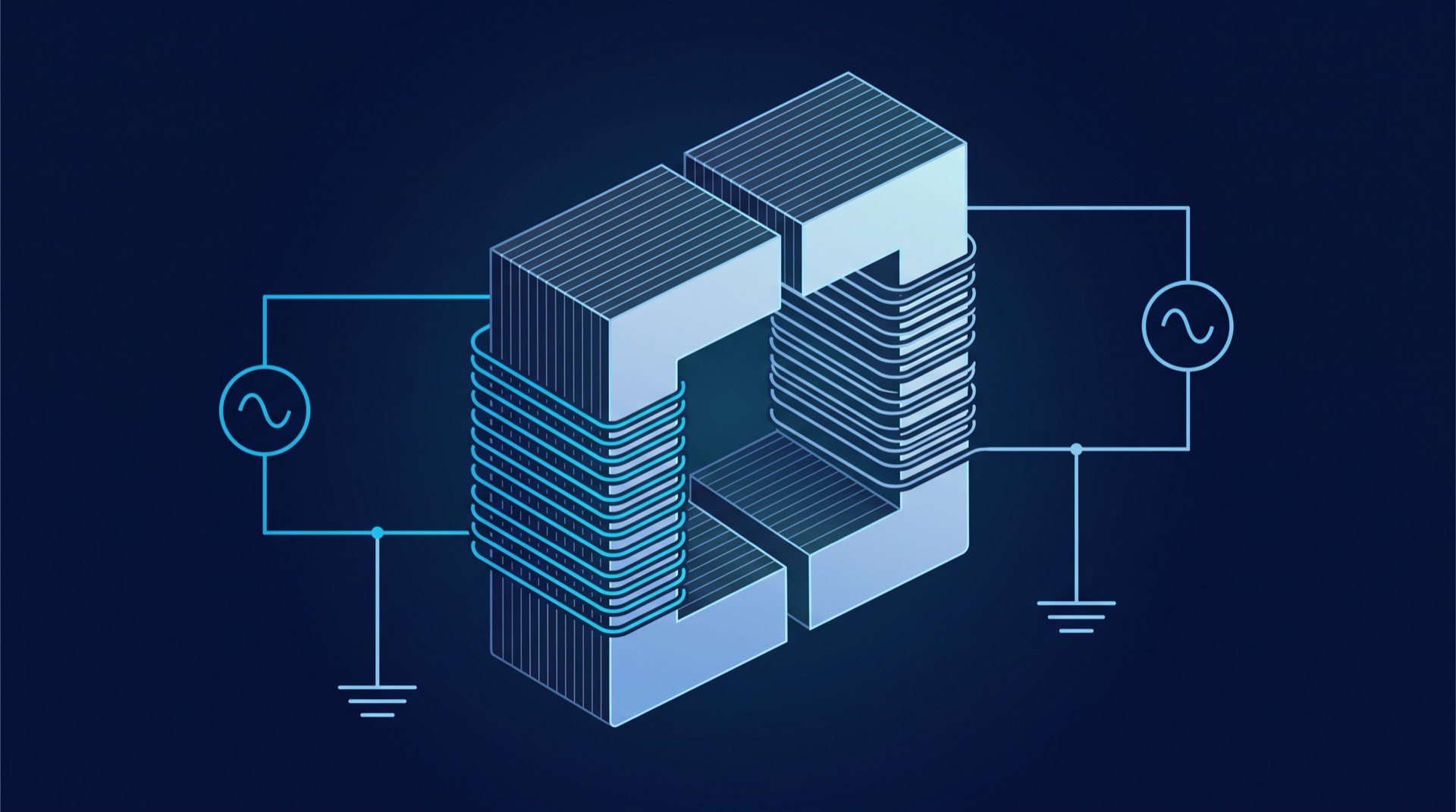
Two circuits are galvanically isolated when no conductive path exists between them: current cannot pass from one to the other through metal. Energy crosses instead as a magnetic field in a transformer core, from a primary winding to a physically separate secondary, carrying nothing of the primary's relationship to earth with it. The neutral-to-earth relationship the load sees is therefore established on the load side of the barrier rather than inherited from upstream. Filtering and conditioning describe useful things a UPS may do, but a filter attenuates a disturbance while leaving a conductive path for it. Isolation removes the path.
Topology is not isolation either, and that is the most common misreading in the category. Online double conversion rectifies the supply to a DC bus and re-synthesises the output from it; the LEON-A datasheet calls the result VFI operation, Voltage and Frequency Independent. That is valuable, and it is not a galvanic barrier. A double-conversion UPS with no transformer still shares a conductive reference between input and output, so a disturbance riding on that reference passes straight through the conversion stages. When a document says isolation, establish which of the two it means.
Why many modern UPS designs leave the transformer out
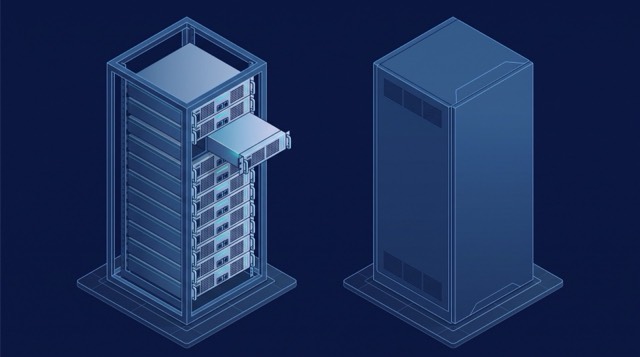
Removing the transformer is not a corner cut; for most of the market it is the correct engineering answer. A transformer is a large mass of iron and of copper or aluminium, with the floor area, weight and waste heat that implies. A transformerless UPS of the same rating is smaller, lighter, cheaper to install, and delivers a higher proportion of what it draws to the terminals.
For a great many installations, nothing the transformer would have bought is needed. A commercial IT room or an office riser is fed from one distribution board, referenced to one earth, over short runs inside one structure, feeding equipment designed for an ordinary mains supply. There the barrier solves a problem that does not exist; ENCLOVE's commercial UPS range is aimed at those environments. The mistake is not choosing a transformerless UPS, but assuming that because a UPS is expensive, online or described as industrial, a barrier must be in there somewhere.
The industrial conditions that make the barrier worth its weight
Industrial sites break most of those assumptions. The supply is shared with equipment that is itself a disturbance source. The earth is not one earth but several, sometimes at different potentials. Runs are long and often leave the building. The protected load is frequently a control system whose failure stops a process. Any one of the conditions below usually settles it.
- Common-mode disturbance travelling between plant areas
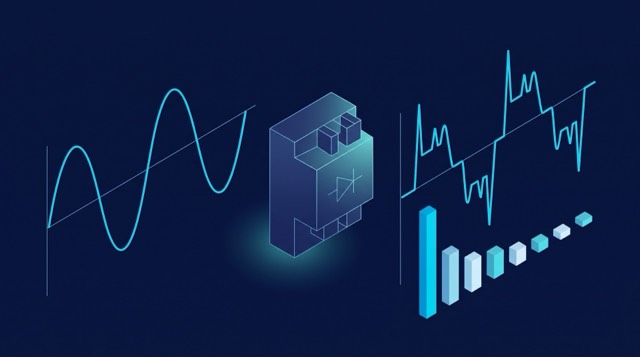
- Drives, contactors and switchgear operations inject disturbance that appears between the supply conductors and earth rather than between phases. Filtering reduces its amplitude but leaves the route by which it reaches the load; a transformer with no through-connection removes the route. This is a frequent cause of a control load misbehaving on a supply that measures as acceptable phase to phase.
- A load that needs its own earth reference
- With an isolating transformer in the output, the load's neutral-to-earth relationship is created at the UPS rather than imported. That gives a separately derived output whose reference you own, which matters when a measurement system or an instrumentation loop should not share a reference with the rest of the plant.
- Leakage paths and predictable fault behaviour
- Isolation changes where leakage current can go; it does not abolish it, and the LEON-A manual carries a HIGH LEAKAGE CURRENT notice stating that the equipment should be operated only after it is earthed. But an earth fault downstream of an isolated output cannot return through the incoming supply. Where the output neutral is referenced to earth at the UPS, fault current circulates inside that derived system, bounded by the machine's own output protection; the LEON-A publishes output current limiting with MCB or MCCB protection on input, output and battery. Where the output floats, a first earth fault produces very little current and becomes a condition to detect rather than an event to clear.
- Long runs, other buildings, and an upstream arrangement you do not own
- When the UPS and its load sit in different buildings, or on a leased site, a shared substation or a plant extension tied into existing distribution, the earth reference at each end may differ, and the upstream arrangement was decided by somebody else who can change it without consulting you. Isolation makes the output's reference a property of your equipment rather than an inheritance from theirs. Marine shore power is the extreme case, which is why ENCLOVE's NSP Series shore power converters are built with galvanic isolation, galvanic corrosion prevention and reverse polarisation protection.
Where the barrier sits: output, bypass or input
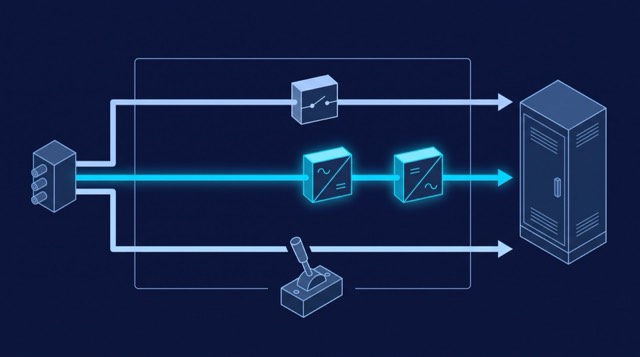
A UPS has more than one path from input to output, and a transformer only isolates the path it is in.
The LEON-A is explicit. Its headline claim is full galvanic isolation between input and output using aluminium or copper transformers; its specification table gives the precise version, Galvanic Isolation Transformer - Output (Bypass & Input Isolation Optional). The output transformer is standard; isolation of the bypass path and of the input are options, which means each is a line on a quotation, and a line nobody asks for is a line nobody supplies.
That matters because the static bypass exists to carry the load when the inverter cannot. Bypass isolation being listed separately is the signal worth acting on: do not assume the standard output transformer covers that route. Ask what the load is referenced to while the unit runs on static bypass. Brief unisolated operation during a fault or a maintenance transfer is often a reasonable trade against a second transformer, but it should be a judgement made at specification, not a discovery made at commissioning. The LEON-A manual adds that a separate bypass input line is possible, so mains and bypass inputs can be disconnected and the bypass fed from its own source, and that the two are connected as the factory default.
The pattern is not uniform even within one range. ENCLOVE's ESD Series thyristor battery chargers publish a standard input isolation transformer in copper or aluminium, putting the barrier between the AC supply and the DC load; the EVR Series industrial inverters carry a standard output isolation transformer, between the DC source and the AC load. Both are described as full galvanic isolation, and they isolate different things because they protect different things.
What to ask a supplier to confirm, rather than assume
Every item below is answerable from a datasheet, a quotation or a manual. An answer that exists only in conversation is itself the answer.
- Which paths are isolated: output only, input as well, or the static bypass too? Get it in the datasheet or on the quotation, not in an email.
- Is the transformer standard on the model quoted or an ordered option, and is it inside the cabinet or a separate unit? On the LEON-A the output transformer is standard, in aluminium or copper, while bypass and input isolation are optional. An external transformer changes footprint, cabling, losses and who installs it.
- Can the bypass be fed from its own source? The LEON-A manual states that bypass and mains inputs are connected as the factory default, so a split bypass has to be asked for.
- How is an earth fault on the isolated output detected and reported? The LEON-A offers DC Earth Fault and AC Earth Fault alarms, four dry contacts as standard and up to sixteen as an option, and ModBus RTU over RS232 with RS485, ModBus TCP/IP, SNMP and IEC61850 available.
- What is the neutral sized for, and where do input harmonics land? The LEON-A manual specifies a neutral cable current rating of 1.4 times rated current, and the datasheet quotes input THDu of 30%, 12% with the 12-pulse rectifier and 5% with an input filter.
What galvanic isolation costs you
The barrier is not free. Weight and volume come first: the isolating transformer is the heaviest single component in most UPS cabinets, driving floor loading, lifting equipment, transport access and room size. Where space or structure is the binding constraint, the calculation sometimes does not close, and that is better discovered during design than on a delivery day.
Then there are losses. A transformer dissipates part of what passes through it, so an isolated UPS delivers a smaller proportion of its input to the load than an equivalent machine without one, and the difference leaves as heat the room must remove. The LEON-A is fan-force cooled as standard, with natural cooling, water cooling and smart fans as options, and its published acoustic noise range is 55dB to 85dB, worth checking against wherever the cabinet is going. Set against that, the transformer is passive, with nothing to wear and no semiconductors to fail, which is part of why the LEON-A datasheet claims a design life of more than 25 years.
When is a galvanic isolation UPS the right specification?
Put it the other way round. A transformerless UPS is right when you control the whole electrical picture: one supply, one earth reference, short runs inside one building, ordinary mains-connected loads, and no plant injecting disturbance into the supply it shares.
A galvanic isolation UPS is right when any of those is untrue, and on industrial sites several usually are at once. Power plants and industrial zones, offshore oil and gas facilities and marine and shore-power systems combine mixed earth references, long runs, disturbance-generating plant and control loads whose loss stops something far more expensive than the UPS.
The LEON-A Series is ENCLOVE's industrial AC UPS family for that case, with data specific enough to specify against: 10-500kVA across three models, the GPL11000 at 1:1 phase up to a maximum of 40kVA and wired 3W (P+N+PE), the GPL31000 at 3:1 phase up to 200kVA and the GPL33000 at 3:3 phase up to 500kVA, both wired 5W (3P+N+PE). Its output carries a galvanic isolation transformer as standard, with bypass and input isolation available as options, and the rugged industrial AC UPS range it belongs to is built for these conditions.
If you are unsure which side of the line an installation falls on, the answer usually follows from two facts: who controls the earthing arrangement upstream of your equipment, and what happens to the process when the load stops.