Modular vs monolithic UPS: what physically differs
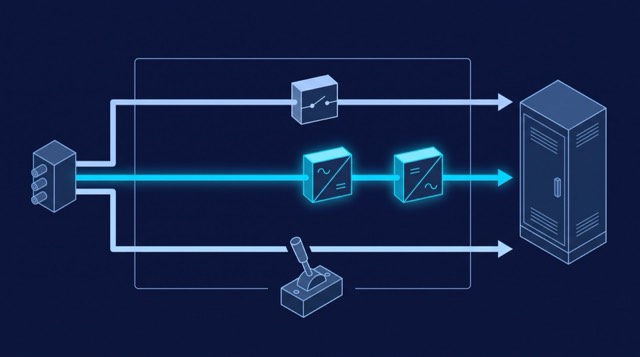
In a modular system the unit of power is the module, and the module is a complete UPS: Centiel describes each Cumulus Power Intelligent Module as carrying three independent power converters, one static bypass and all hardware and software functions, so it can isolate itself when a fault occurs. A monolithic unit has one of each.
That sets the granularity of everything downstream. Cumulus Power modules are rated 10/20/25 or 50/60 kVA=kW, in frames from 50 to 600 kVA=kW taking up to ten modules, across 10kW-3.6MW. Stratus Power modules are rated 10 / 20 / 25 / 30 or 50 / 62.5 kW, in frames from 60 to 1500 kVA = kW taking up to twenty-four modules, across 10kW-3.75MW. The smallest increment you can buy — and the largest block you can lose — is one module.
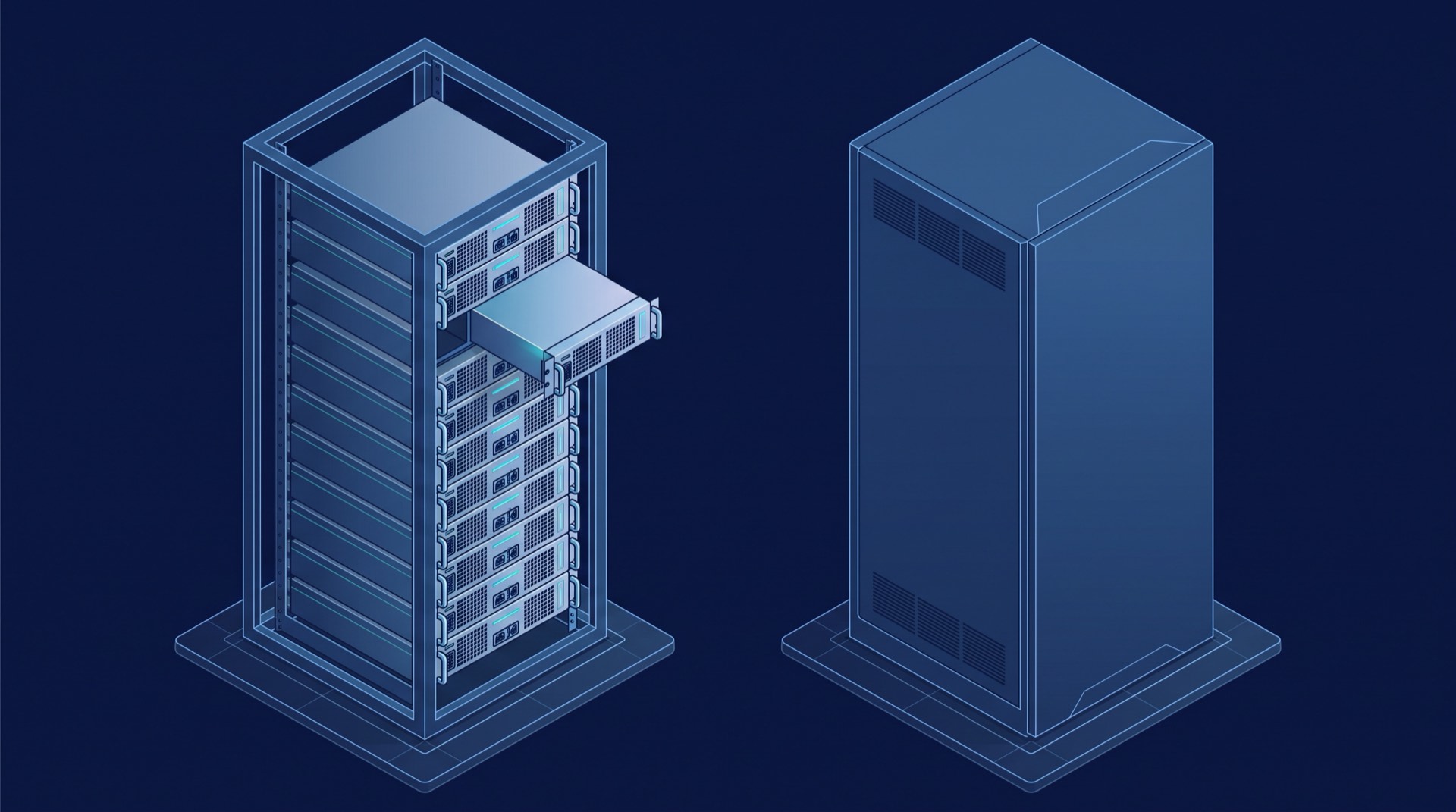
A Stratus SM10 to SM30 module weighs 19 kg at 132 x 443 x 490 mm; a Cumulus 600 kVA=kW frame weighs 396 kg empty. The heavy part stays put; the part that fails is carried in by hand.
The capital profile: buying the capacity you need now
“Flexibility to Pay as You Grow” is the Cumulus datasheet's phrase: buy the frame for the end state, populate it for today's load. A Cumulus CP251-E-B0 frame takes one to ten modules to 250 kVA=kW; a Stratus CAB-SP1500 frame takes twenty-four SM50/SM62 modules to 1500 kVA = kW.
Three things decide whether that is a saving. The frame is not free: enclosure, distribution, manual bypass and cabling are sized for its full rating and bought on day one, so the deferred spend is modules and batteries only. The growth curve has steps: inside a frame capacity is granular, at the boundary it is not. Cumulus tops out at 600 kVA=kW per frame and 3600 kVA=kW per system, Stratus at 1500 kVA = kW per frame; a forecast that crosses a boundary buys a frame, with its own floor space and commissioning. And ask how long this module stays orderable, and whether one built years from now runs in this frame at this firmware revision: an architecture whose modules go end-of-life early is a monolithic system with extra connectors.
Mean time to repair and concurrent maintainability
Availability is governed by how often a system fails and how long restoring it takes. Modularity does little about the first and much about the second: it attacks mean time to repair.
Cumulus Power claims modular design allows fast replacement of Intelligent Modules, reducing Mean Time to Repair, with >10 years DC capacitor life cutting spare-part cost. Stratus Power's brochure states DARA at frame level was designed for non-intrusive maintenance and to minimise MTTR — frontal access avoids removing modules, deleting a step where human error happens — against 15+ years of life on replaceable components and a 30+ years UPS design life.
The operational difference belongs in the specification. On a monolithic unit, internal repair usually means transferring the load to the maintenance bypass — ENCLOVE's LEON-A industrial UPS has one for that purpose — so the critical load runs on raw mains, and the protection you bought is out of circuit for the duration. In a redundant modular frame a module is isolated and swapped while the others hold the load in double conversion — for datacenter and telecom sites, that is the whole concurrent-maintainability argument.
And hot-swap is worthless without the spare: a module you do not stock is on a lead time.
Part-load efficiency, and why the load profile decides
Almost every UPS is specified for a future load and spends years below it. Fixed losses do not shrink with the load, so double-conversion efficiency falls as utilisation falls in any topology.
A modular system can change that: the number of energised modules is a variable. Cumulus Power's Maximum Efficiency Management matches the number of modules to load demand: at low load, modules not needed to maintain redundancy go into Active-Sleep and return instantly online as load rises. The Cumulus datasheet plots efficiency against output load and marks a “Typical operating range” and a “Power Saving” region. A monolithic unit has no equivalent lever; its rectifier and inverter are sized once.
The headline figures — 97,1% inverter efficiency and 99,4% on bypass for Cumulus Power, 97,6% and 99,4% for Stratus Power — are values at a rating point, not curves; they say nothing about behaviour at a third of rating, where the system may live for years. Ask for efficiency at the load points you will actually run, in double conversion rather than an energy-saving mode, for the exact frame and module combination quoted.
Footprint and power density
Density is the least ambiguous advantage. Stratus Power is published at 1MW per M², and the cabinet table bears it out: 375 kW in 0.59 m², 750 kW in 1.18 m², 1,125 kW in 1.77 m² and 1,500 kW in 2.36 m². Cumulus Power's 150 kW frame occupies 0.41 m² and its 600 kW frame 1.19 m².
At the small end the architecture buys different flexibility: Stratus is also supplied as a Universal Rack fitting any 19-inch rack, from 600 mm deep, at 8 HU, 12 HU and 21 HU for 10 to 30, 10 to 60 and 10 to 120 kW per rack — no separate UPS enclosure in an edge or telecom room.
Two things temper it. Footprint is not required space: front access, module extraction clearance, cable entry and battery accommodation govern the layout. And density concentrates heat; both families are rated 0-40°C with no power derating and to 1000 m, derating 1% for each additional 100 m, so the burden shifts to the cooling design.
What is actually shared between the modules?
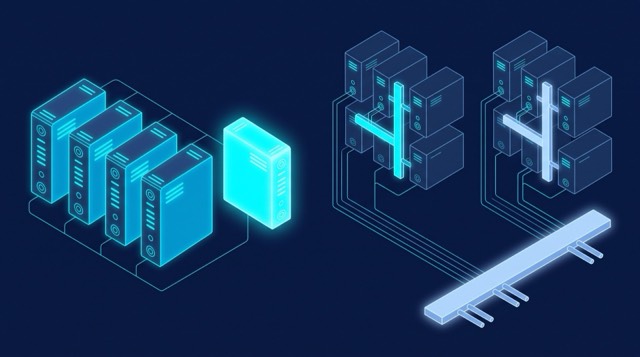
“No single point of failure” is a claim about a particular architecture, not a property of modularity: modules sharing one static bypass, one control card and one battery string are a monolithic UPS with a partitioned inverter. Four questions separate them.
- The static bypass
- Does each module carry its own, or does one serve the frame? In DARA each module has three independent power converters and its own static bypass, and can isolate a fault without impacting the load. A shared static bypass sits in the load path of every module — put it on your single-point-of-failure list.
- Controls and the communication bus
- Master-slave control concentrates decision-making in one place. Centiel's Distributed Decision Making has modules decide collaboratively — described as eliminating the single point of failure typically associated with master-slave technology — over a triple-mode parallel bus. Ask what happens when that bus is severed.
- Frame wiring, protection and the output bus
- Some is per-module, some is not. The Universal Rack lists DC battery MCB protection at one per module, bypass fuses at three per module and an output parallel isolator at one per module — but the system manual bypass is one device for the whole system, as is the output busbar. Name the shared items in your redundancy analysis.
- The battery
- If every module draws from one common string, that string is a shared single point of failure however many modules sit above it. Both families allow a choice — the DARA block diagrams show a battery set per module — with Stratus DCFlex spanning 240 - 600 Vdc at 50 A per module against Cumulus at 360-480 Vdc. Price the industrial battery replacement cycle each implies.
Is N+1 counted per module or per system?
The commonest specification failure in modular procurement is an N+1 nobody pinned down: it can mean one spare module inside a frame, one spare frame in a multi-frame system, or a redundant pair of systems feeding dual-path distribution. Stratus Power claims availability maximised at module, frame and system level — three separate statements, and only one may be in your quotation.
Work an example on a 300 kW load. Ten SM30 modules at 30 kW each is exactly N, and the largest SM10 to SM30 frame takes ten modules, so module-level N+1 needs an eleventh module and therefore a second frame. On SM62 modules, five at 62.5 kW covers the same load and the CAB-SP375 frame takes up to six, so N+1 fits one 1982 x 656 x 900 mm cabinet at 0.59 m². Same load, same family, same redundancy in name; two bills of material, two failure domains.
The datasheet also says what happens when a module drops out. Stratus publishes continuous overload per module — 12 / 24 / 30 / 36 kVA = kW on the small modules, 60/75 on the large — and 450 to 1800 kVA = kW per frame across the SM50/SM62 cabinets; Cumulus publishes inverter overload of 124% continuous, 125% for 10 min and 150% for 1 min. So write the requirement as a number: this many modules of this rating, in this named frame, at this load, module and system redundancy stated separately — because an availability figure such as the 99.9999999% both families publish is the output of a model whose assumptions are the specification.
When a monolithic UPS is still the right answer
None of this makes modular universally correct; a monolithic unit is the better buy in several ordinary cases.
- The load is fixed and known. Pay-as-you-grow pays nothing; you buy maintainability alone.
- The environment is the hard requirement, not the capacity. LEON-A covers 10-500kVA on a 110 - 384VDC DC bus with galvanic isolation, online double conversion to IEC 62040-3 Class VFI and THD < 2 % at linear load.
- The load is small. Below the point where a frame earns its cost a single unit is simpler; ENCLOVE's three-phase EON 33 series covers 80kVA - 200kVA at fixed ratings.
- There is no spares strategy. Modularity's advantage needs stocked modules and a trained procedure; without both, a simple machine on a service contract delivers more availability.
- Redundancy already exists elsewhere. If two independent systems feed the load through a static transfer switch, module-level redundancy inside each may be spending on the wrong layer.
- Reduce it to four written answers — the load curve and its date, the maintenance regime, the shared-element list and the redundancy statement — and the modular vs monolithic UPS choice usually answers itself.