Why a 60 Hz vessel cannot plug straight into a 50 Hz quay
Frequency is not a parameter equipment tolerates loosely. Most of a ship's load is rotating machinery — pumps, fans, compressors, winches — and an induction motor takes its shaft speed from the supply frequency and its pole count. Feed the same motor at a lower frequency without lowering the voltage and it turns proportionally slower, its magnetic loading rises, and the fan on its own shaft moves less cooling air while that happens. Transformers behave similarly; timing-sensitive bridge, communications and automation electronics have their own sensitivities.
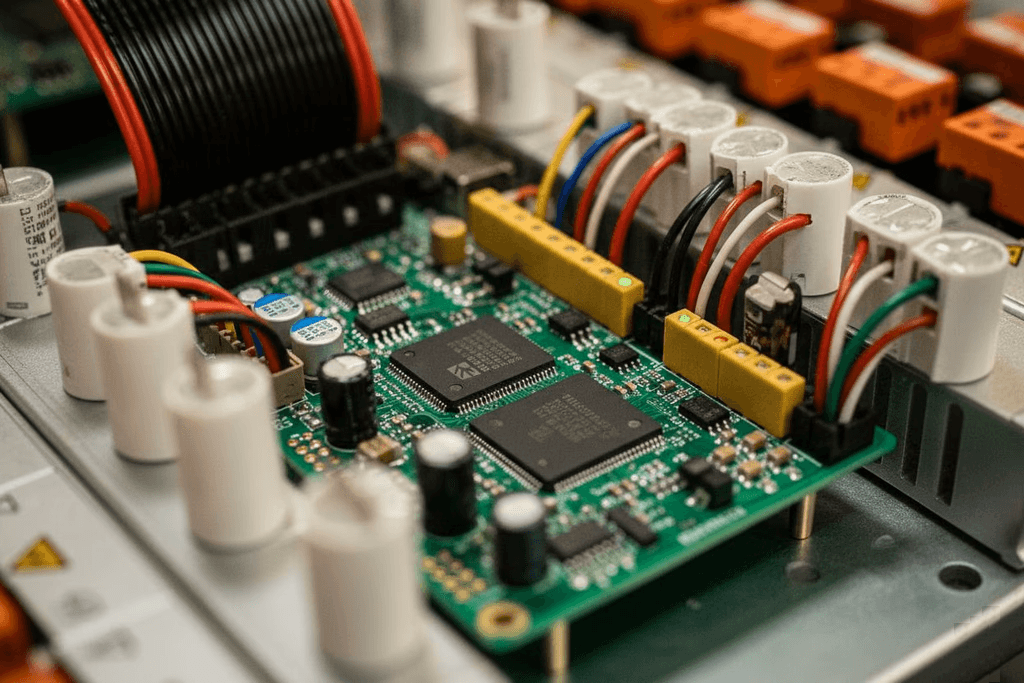
Equipment, not procedure, has to resolve that. Static conversion works in two stages: ENCLOVE's frequency converters rectify the incoming AC into a filtered DC link, then invert it into the frequency and voltage the load needs — the PROTEUS overview describes exactly this double-conversion structure, with separate rectifier and inverter modules. Because the output is synthesised rather than passed through, the same box also corrects a voltage mismatch and holds its output steady while the input wanders.
A third frequency belongs to naval and aviation-adjacent work: 400 Hz, where the higher frequency allows smaller magnetics for a given power. Both ENCLOVE series publish 50/60/400Hz frequency options, so conversion is a fixture of marine power systems, not a workaround for an unusual berth.
Shore-side or ship-side: where the marine frequency converter belongs
Conversion can sit on the quay or on the vessel, and the choice is mostly about ownership, utilisation and space.
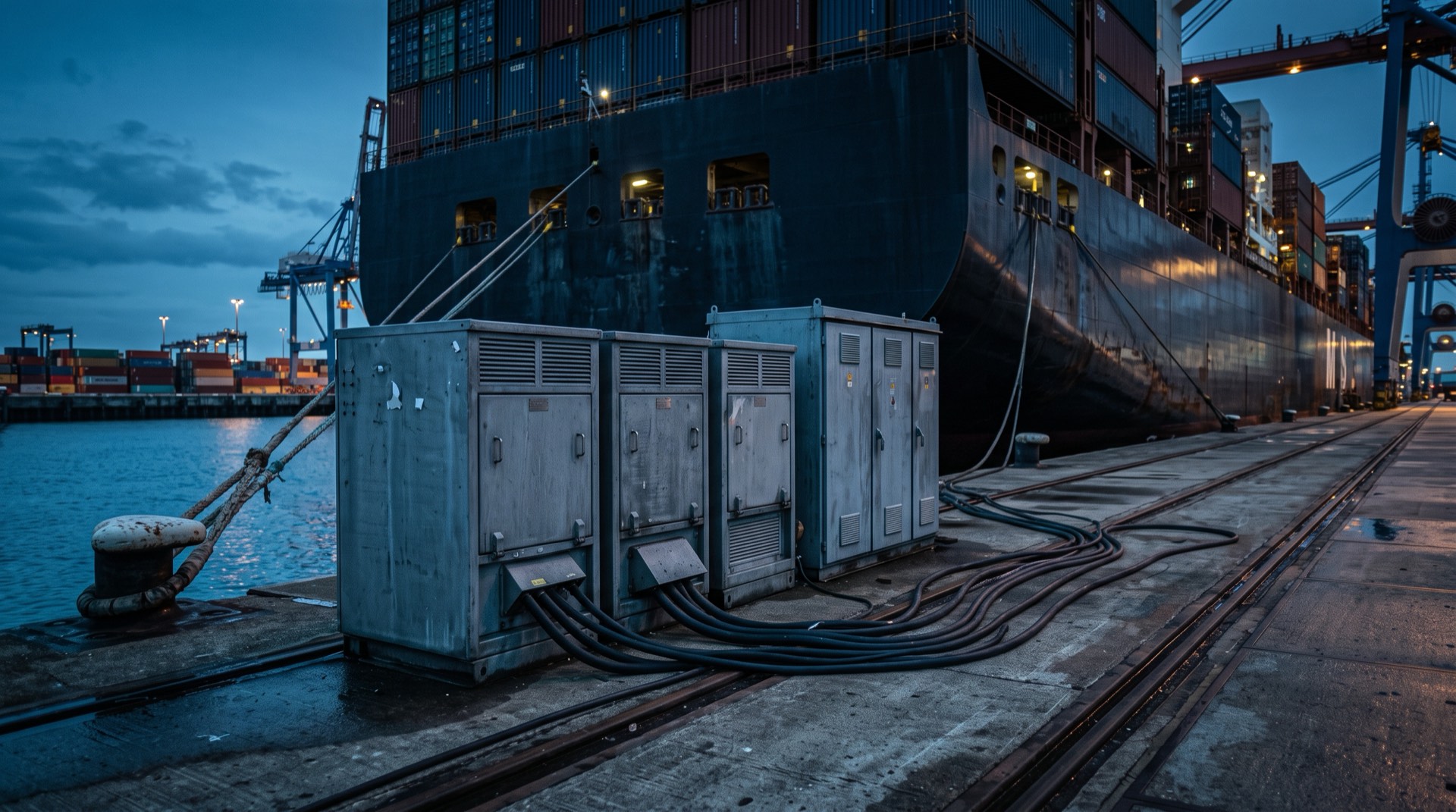
A shore-side converter serves whichever vessel berths there: the port or marina owns it, maintains it, and rates it for the largest connection expected. ENCLOVE positions the NSP Series shore power converter for this duty — its overview names dockside shore-to-ship connection, commercial marinas, shipyards and railway transit infrastructure — with IP54 ingress protection as standard (IP55 optional) for a cabinet that lives outdoors in salt air.
A ship-side converter travels with the vessel and works in every port on the route, the only way to guarantee compatibility across a trade that mixes 50 Hz and 60 Hz supplies. The price is space, weight and vibration exposure: the PROTEUS Series modular frequency converter lists optional vibration absorber pads, and its default IP20 enclosure (up to IP55 optional) suits a converter room rather than an open quay.
- Shore-side: one asset serves many vessels, but must be rated for the largest and earns nothing while the berth is empty.
- Ship-side: compatibility travels with the hull, at one converter per vessel instead of one per berth.
- Either way, someone owns the interface — cabling, earthing, protection settings, metering, documentation.
What a shore power converter has to deliver besides frequency
Frequency is the headline, not the specification. A shore connection has to match the vessel on several axes at once.
- Voltage matching, not just frequency
- Vessel switchboards are not all built to one nominal voltage, and neither are ports. The NSP table lists outputs of 208/380/400/415/440/480/690 VAC 3P+PE (N Optional) held to Static ±1%, Dynamic ±3%, from an input range of 170 – 520V 3P + PE; other input voltages via an input transformer. PROTEUS lists a 380 – 480V ±10% input, with other output voltages available via an output transformer. Settle the neutral too: both series offer 3P or 3P+N input, and on the NSP output the neutral is an option.
- Galvanic isolation between shore and hull
- A shore connection creates a metallic path between the port's earthing system and the hull; any potential difference across it drives current through whatever conducts — the hull, its fittings, its anodes. Isolation in the converter breaks the path. NSP lists complete galvanic isolation between input and output, galvanic corrosion prevention and reverse polarisation protection; on PROTEUS a fully isolated output comes with the optional output transformer. Decide where isolation lives on the drawings, not at energisation.
- Harmonic behaviour in both directions
- The converter is a large non-linear load on the port network and the vessel's only source, so distortion matters twice. Both series list input current harmonics of <3% THDi at nominal load with an input power factor >0.99. On the output, NSP quotes Linear Load <1% / Non-Linear Load <3%, PROTEUS <2.5% THDv at linear load with a 3:1 crest factor. Ask for figures at the load you will actually run — a berth spends much of its life lightly loaded.
How a shore connection behaves when the vessel's load comes across
A generator set has rotating inertia and a short-term fault contribution well above its continuous rating. A static converter has neither; it has instead a published overload envelope set by its semiconductors and its thermal design. NSP lists 10 min. @ <125% Load and 1 min. @ <150% Load with a short-circuit rating of 2 sec. @ 200% Load; PROTEUS lists 10 mins. @ <120% Load, 30 sec. @ <150% Load and the same 2 sec. @ 200% Load. Those lines decide whether a large direct-on-line motor start is acceptable across the shore supply, or whether the vessel has to sequence its loads as it comes across.
Transfer is the other half. Taking hotel and auxiliary load off the ship's generators without a dead-bus break means both sources share load through the changeover. PROTEUS states that it can operate in parallel with generators and other SFCs, sharing load without any communication link thanks to programmable droop control, and lists uninterrupted load transfer between sources; NSP supports dual input configurations with optional seamless generator transfer without dropping critical loads. Both are capabilities to specify and commission deliberately, with the changeover sequence agreed in advance.
The payoff of shore power follows from that mechanism: with the load carried from ashore, the auxiliary engines can be stopped at the berth, and the generation — its noise, exhaust and running hours — happens somewhere else. One consequence is easy to miss: a converter's contribution into a fault is not a generator's, so discrimination coordinated against the ship's own machines has to be re-checked against the converter's short-circuit rating.
Sizing a shore power converter: modules, kVA and headroom
Both series are built from modules, which makes the rating a procurement decision rather than a catalogue pick. Both publish module power of up to 100kVA. NSP scales from 10kVA to 1000kVA by horizontal expansion; PROTEUS spans 40kVA - 40MVA, its datasheet stating that by parallel connection up to 40MVA can be supplied. Three things routinely go wrong at this step.
- kVA is not kW. Both series list an output power factor of 0.9 (1.0 optional on NSP), so size against the berth's real load in kW and its power factor.
- Nameplate is not nameplate in a hot climate or at altitude. Both de-rate at 2% power loss per 1°C above 40°C, up to 50°C. NSP publishes altitude correction factors of <1000m, Correction Factor 1. / <2000m, Correction Factor >0.92, / <3000m; Correction Factor >0.84; PROTEUS states 1% power loss for every 100m up to 2000m over 1000m.
- Losses become heat in the room. NSP quotes 94% efficiency, PROTEUS >96% (without isolation transformers) at 50/60 Hz and >93% at 400 Hz. The difference leaves by forced-air cooling with fan speed adjusted to load, or by the optional liquid cooling both offer at 6 L/min flow rate per 100 kW.
- Redundancy comes out of the same modularity: PROTEUS rests its reliability case on the modular structure plus a spare module, NSP on horizontal expansion for capacity upgrades and rapid servicing. Decide how much rating you can lose with a module out, and buy that headroom at order stage.
The quayside installation: enclosure, environment and cable runs
Everything above is electrical. What stalls shore power projects is usually physical.
Environment first. NSP is specified with IP54 ingress protection as standard (IP55 optional), conformal-coated printed circuit boards and a built-in marine filtration system, at 0 – 50°C operating, -20 – 70°C storage and humidity <95% without condensation; PROTEUS starts at IP20 and reaches IP55 as an option. For a cabinet in an unconditioned kiosk at the head of a berth, in salt-laden air, that distinction is most of the specification. Noise matters near accommodation or a marina: NSP quotes <65 dBA, PROTEUS 65-75 dBA, fan speed following the load.
Then the cable. A berth is long, the connection point moves with the vessel, and the cable carries the whole load current. Volt drop over that distance is a real constraint — PROTEUS lists output cable voltage drop compensation — and the higher of the available output voltages carries a given power at lower current, which is lighter, cheaper cable. Handling and mechanical protection of that cable is quay engineering, and needs an owner.
Footprint costs the most to get wrong. Both series ship as standalone cabinets with roof lifting eyes, and both datasheets state that dimensions are available on request — so get dimensions, weights, cable entries and service clearances in writing before the civil design freezes. Monitoring closes the loop: NSP lists RS232, RS485, MOD-Bus, J-Bus, CAN-Bus with SNMP and dry contacts optional, and real-time logging of up to 2,000 events, which is what you want the morning after an unexplained trip.
Certificates, documentation and what to settle before order
Marine certification is a formal status a classification society confers on a specific product configuration after assessment. It is not a property of a product family, and cannot be read off a brochure.
ENCLOVE's product data is explicit about this. The NSP marine standards line reads "Marine certifications available upon request (BV, DNV GL, ABS, RINA, CCS, LR) (Optional)"; the PROTEUS line reads "Marine Certificates on Request (BV, DNV GL, ABS, RINA, CCS, LR)". Read those as scope to be agreed for an order, not as approval already in hand. Where a project needs class involvement, ask for the certificate itself — issuing society, the exact configuration covered, its scope and its validity — and name those documents in the purchase specification.
A shore power connection is also subject to standards and to local regulation at the port, while the vessel's own class arrangements apply on the ship side of the interface. Agree early who demonstrates what, to whom, and with which documents.
- Nominal voltage, frequency and phase configuration on both sides, and whether a neutral is required.
- The earthing arrangement, and exactly where galvanic isolation sits.
- Short-circuit data on both sides, and the protection settings that have to discriminate.
- Load profile: continuous load at berth in kW, the largest single step, and the pick-up order.
- Ambient conditions at the converter's actual location, not the site average.
- Certification scope in writing, with the certificate documents named.
- Cable route and connection point, and who owns the cable and its handling equipment.