What an oil and gas UPS actually has to keep alive
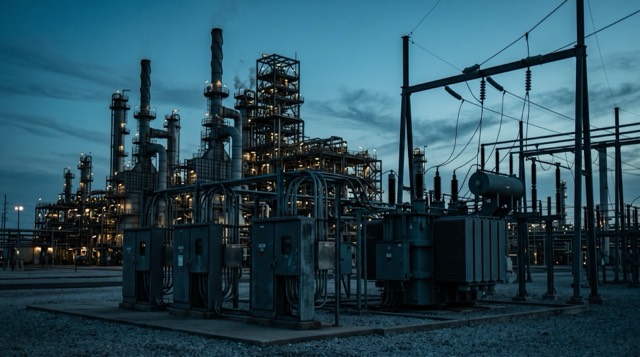
Start from the load schedule, not from the switchboard. In an upstream or refining facility the supplies that must not lapse are mostly small, and mostly not the process itself: distributed control system cabinets and the emergency shutdown and safety instrumentation beside them; the field instrumentation loops feeding them; gas detection; metering and cathodic protection; telemetry and SCADA at unmanned sites; offshore navigation and warning lights; the solenoids and actuators through which a shutdown command becomes movement; and the emergency lighting that lets people leave.
ENCLOVE's own account of the sector puts it plainly — power supports the systems that see, measure, communicate, and respond. A pump that stops is a production loss and usually a load that will restart. A control system that stops is a facility operating without instrument readings, without alarms and without the means to shut itself down in an ordered way. That is a process-safety event with a power system at the root of it, not an outage.
Two consequences follow. The critical load is small relative to the plant, so protecting it thoroughly is cheap. And its value is asymmetric: an hour of autonomy on the instrument supply is worth more than an hour on the largest motor on site.
Why instrumentation power is usually a 24V or 48V DC UPS
A DC system is the oldest answer to continuity and still the best one for instruments. A rectifier and a battery sit in parallel on the same bus: the rectifier carries the load and charges the battery, and when the AC input fails the battery is already connected. No transfer, no detection delay, no switching event: the bus simply falls back onto the battery. For a logic cabinet or a two-wire loop, that is the shortest path to a supply that is never interrupted.
ENCLOVE covers this at two scales. The ESD Series industrial DC UPS is a thyristor charger for substation and industrial control duty: outputs of 24VDC / 48VDC / 60VDC / 110VDC / 125VDC / 220VDC / 250VDC / 400VDC / 600VDC held to < 0,5% regulation, 10A to 200A single-phase and 10A to 2000A three-phase, with output ripple of <4% and <1% respectively. Ripple matters here in a way it does not on a motor supply: on a shared instrument bus it is measurement noise. A standard input isolation transformer gives full galvanic isolation between the AC side and the DC loads.
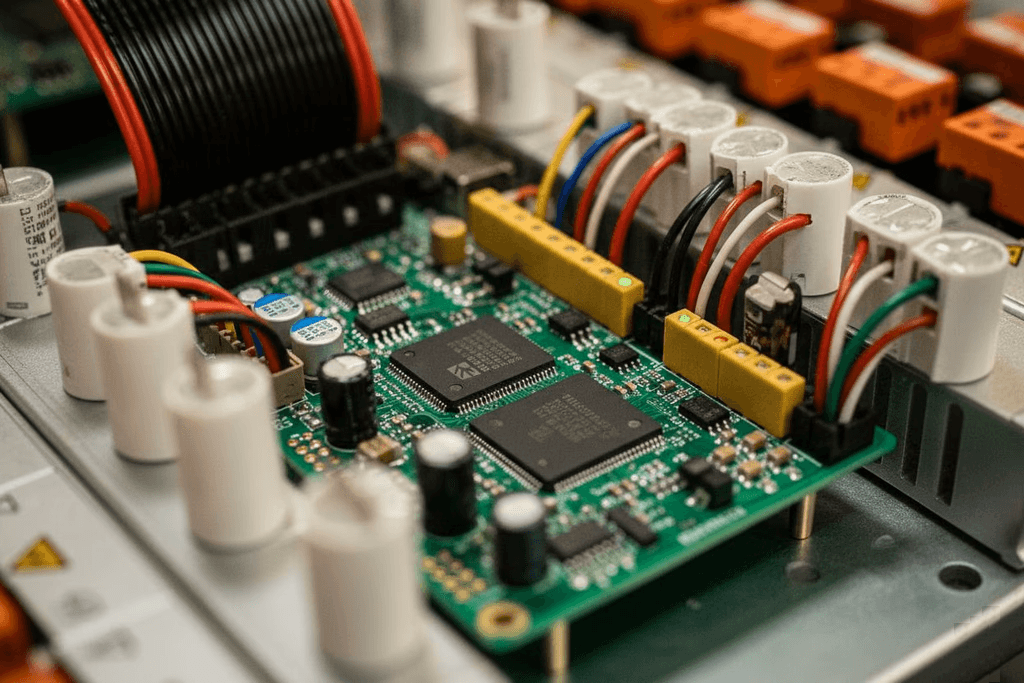
Where the site is smaller or distributed, the ETR Series modular rectifiers do the same job out of hot-swap modules. The ETR1524 is 1500W at 27Vdc adjustable from 21Vdc to 29Vdc, up to 62.5A @ 24Vdc; the ETR3048 is 3000W at 53.5Vdc adjustable from 43Vdc to 58Vdc, likewise 62.5A @ 48Vdc. Modules share current to within ≤±5% of max current from 20% to 100% load, so N+1 is a matter of adding one, and both accept 85Vac to 305Vac at 45Hz to 66Hz — the input a weak site supply or a running generator actually delivers. The ETR1524 datasheet names its applications as alarm systems, control and monitoring, and relay logic (PLC): the instrumentation load, described from the supply side.
Where an AC UPS belongs instead of a DC system
Not everything in the control loop is content on 24V. Operator and engineering workstations, servers, analyser houses, telecom equipment with AC inputs and panel cooling want mains-quality AC — and they want it clean, because the generators, long cable runs and motor starts that trouble instruments trouble them more.
The LEON-A Series industrial AC UPS is the AC counterpart: online double conversion with VFI (Voltage and Frequency Independent) operation, so the load runs continuously off the inverter rather than being switched onto it. The three models are rated Max 40kVA at 1:1 phase, Max 200kVA at 3:1 and Max 500kVA at 3:3, on a battery voltage of 110VDC / 220VDC / 384VDC. Output THDu is 2% at linear load, recovery time 25ms to within 1%, and the overload envelope is 110% load continuous, 110-125% for 10 minutes and 125-150% for 1 minute. A galvanic isolation transformer on the output is standard, with bypass and input isolation optional — worth having where load and supply share an earthing system you do not control. Up to 4 units can be paralleled, dual redundant or for capacity.
A third arrangement avoids buying a second battery. Where the site already has a DC battery for instruments, the EVR Series industrial inverter makes AC from it: 24VDC to 220VDC in on the EVR1 Series and 24VDC to 600VDC on the EVR3, out at 110VAC to 600VAC defined on order, up to 200kVA and 500kVA respectively. Its datasheet quotes a wide ±25% input DC voltage range, which is the point: a battery on discharge is a moving target, and the inverter has to hold its output while the bus sags.
Remote and unmanned sites: autonomy, temperature and the alarm path
On a manned refinery, autonomy buys the time to start a generator or call someone out. At a wellhead, a pipeline block valve station or an unmanned platform, it buys the time to get a technician there — a number set by weather, boat or helicopter availability and daylight, not by electrical engineering. Ask for it in hours, and have the operations side own the figure.
- Batteries do the work, so their design life sets the maintenance interval. ENCLOVE's industrial battery range publishes 10-12 years of design life for VRLA, 15 for OPzV, more than 15 for OPzS and more than 20 for Ni-Cd — and the charger has to suit the chemistry. The ESD Series lists VRLA / OPzV / OPzS / NiCad, with charge voltage set by battery type and current by battery capacity, a 0 - 20 hour boost charge timer, temperature-compensated charging and low-voltage disconnect.
- Temperature is the specification that gets missed. The ESD Series and the LEON-A both operate from -10 to 50°C and store from -25 to 70°C; the ETR modules run from -40°C to +75°C, de-rating above 55°C. All de-rate with altitude — rated at 1000m from MSL, then 1% derate each 100m above it. Use the ambient at the equipment, not the site average.
- The alarm path is part of the power system. With nobody on site, an unnoticed charger failure means the plant is quietly running on a battery that nothing is replacing. The ESD Series ships ModBus over RS232 with 4 settable volt-free contacts as standard, and offers RS485, TCP/IP, IEC61850 and 16 contacts; the LEON-A and EVR Series add ModBus TCP/IP and SNMP. State which alarms are mapped individually rather than summed into one common-trouble contact.
- Serviceability decides repair time once travel is inside it. The ETR modules are hot-swappable with an MTBF of > 300,000 hrs @ 25°C, so a failed module is a plug-in job with the system live. A monolithic unit is a shutdown, a permit and a trip.
The electrical room, the e-house and the atmosphere around them
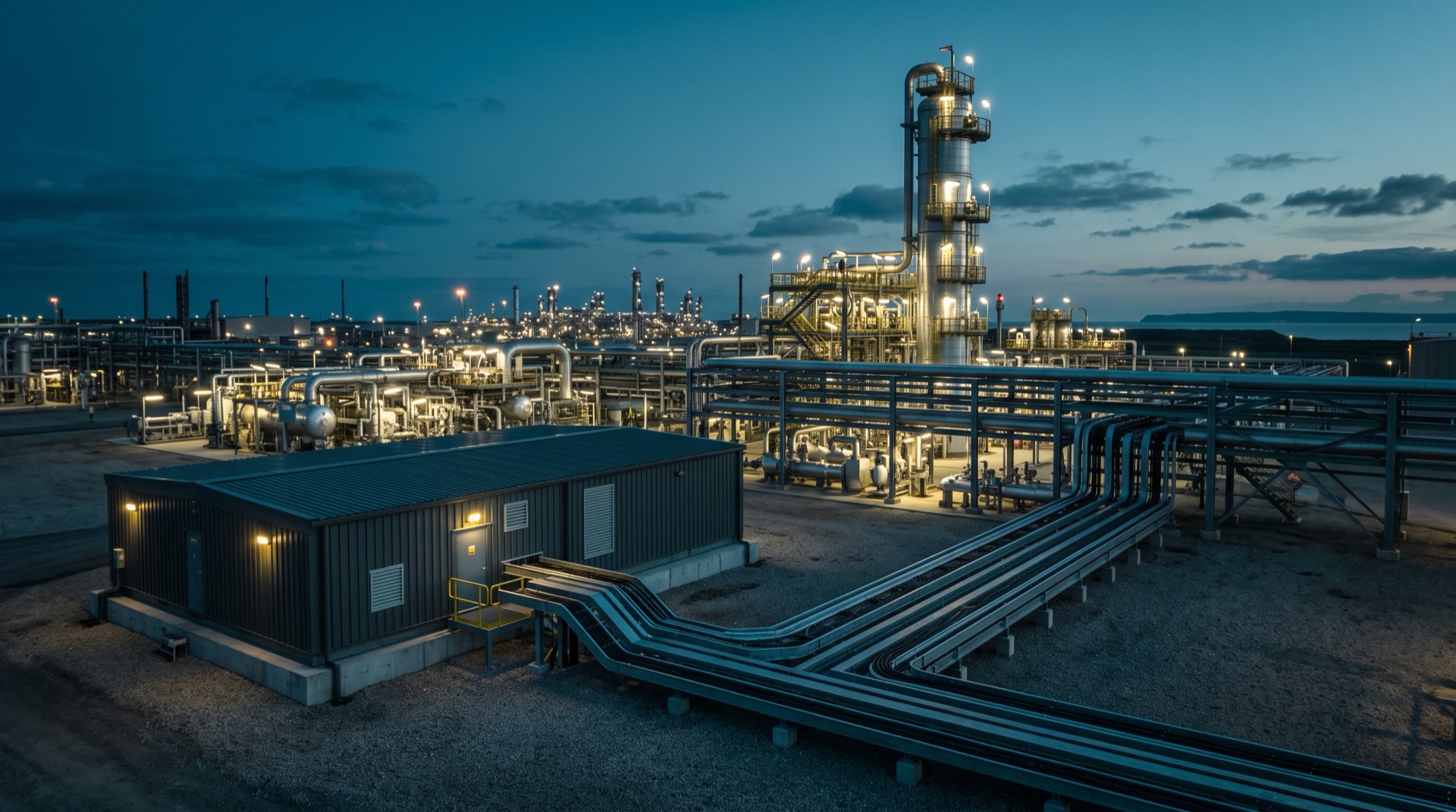
Upstream and coastal facilities include classified hazardous areas, and equipment installed in them is subject to certification and to the operator's own engineering standards. That is a project-specific question with a documented answer, to be confirmed with the supplier and the certifying body for the exact configuration being purchased, before any design is frozen. Everything below concerns equipment in a safe-area electrical room or e-house, feeding loads that may sit in a classified area beyond it — the ordinary arrangement, and the one that keeps the power equipment somewhere it can be maintained.
With the boundary drawn that way, what you are actually buying is the room: floor loading, cable entry, service clearance and cooling. Both the LEON-A and the EVR Series list bottom cable entry as standard, fan-forced cooling with natural, water and smart-fan options, and full front access, so a cabinet is serviceable without side clearance — a real constraint in an e-house where cabinets are bolted in a line.
Then the atmosphere. Salt and humidity are why oil and gas equipment reads differently from the same equipment inland. The ESD, LEON-A and EVR Series are all rated to 0 to 95% relative humidity, non-condensing — note the qualifier, which is a statement about the room as much as the cabinet. Ingress protection is the lever: the ESD Series is IP20 with IP21 to IP54 optional, the LEON-A and EVR Series IP20 with up to IP55 optional. ENCLOVE lists the LEON-A and the EVR Series for offshore oil and gas platforms as resistant and corrosion protected units, and the ESD and EVR Series both offer a cabinet heater — which holds the enclosure above the dew point, and that is what actually keeps condensation off a board.
How to specify instrumentation power so the bids compare
Most of the spread between quotations for the same duty comes from ambiguity in the enquiry rather than from the suppliers. A specification answering the following returns bids you can put side by side.
- Load per bus: continuous DC load in amps at the nominal bus voltage, AC load in kW with its power factor, and the largest single step.
- Autonomy in hours per bus, the scenario it covers, and the recharge time expected afterwards.
- Battery chemistry, or the design life wanted with the choice left open — VRLA, OPzV, OPzS and Ni-Cd differ in footprint, ventilation and replacement interval.
- Nominal DC voltage and the allowable voltage window at the load. That window, not the nominal, decides whether a bus works at 24V or has to be 48V.
- Redundancy stated as an architecture, not a word: N+1 modules, two chargers on one battery, two independent systems, or a duplicated battery.
- Ambient temperature and altitude at the equipment's location, and whether the room is conditioned.
- Ingress protection per cabinet, the monitoring protocol, which alarms are reported individually, and how many volt-free contacts are required.
- Certification and documentation scope as named documents, with a responsible party against each — plus dimensions, weights and service clearance in writing before the building or skid design freezes.