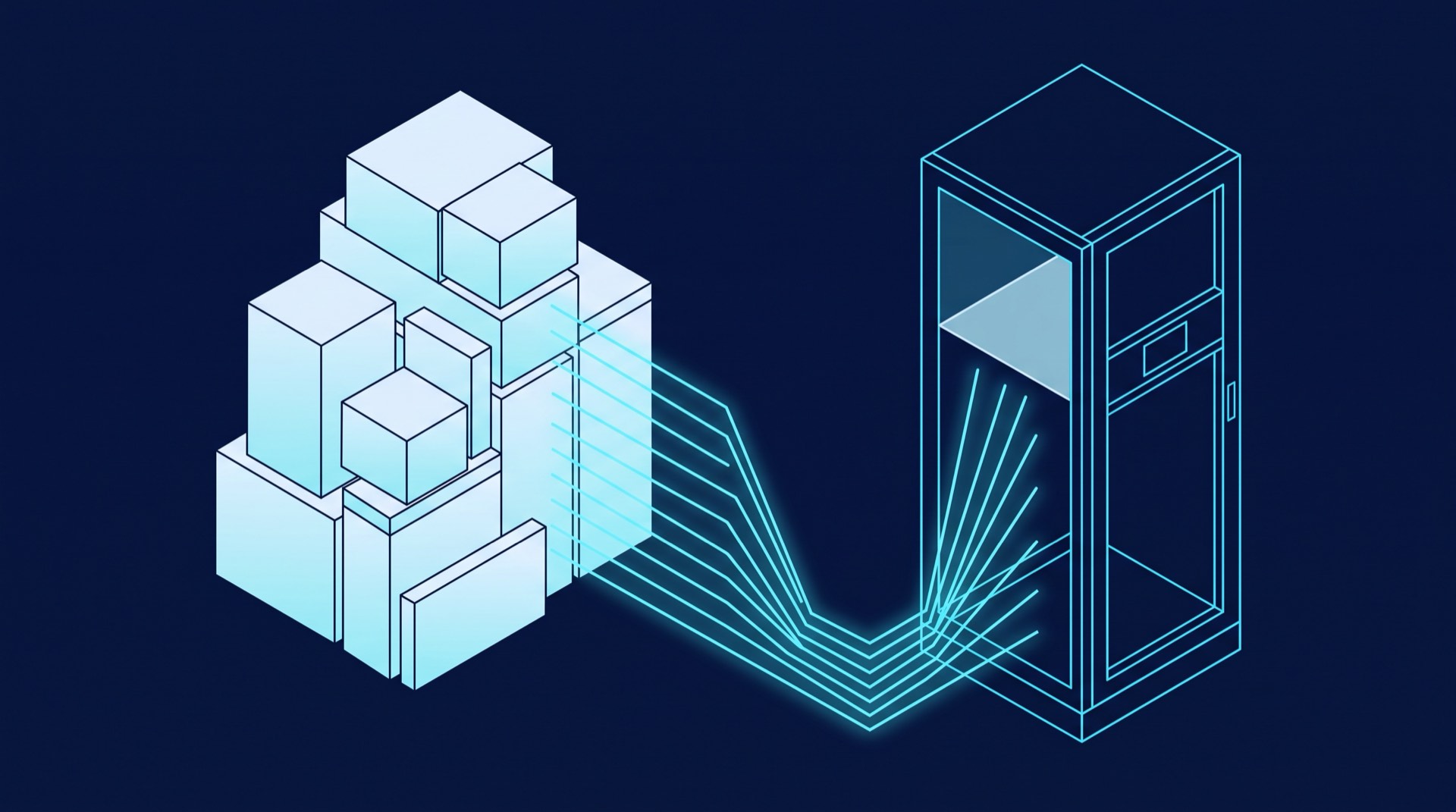
Start with a load inventory, not a kVA number
A UPS is sized to the load it will actually carry, and the only reliable description of that load is a list. For every circuit that has to survive an outage, record the equipment, its nameplate rating, whether that rating is printed in VA, watts or amps, the power factor if the nameplate gives one, and how the equipment behaves at start-up.
Nameplate ratings are a starting point, not an answer: manufacturers publish worst-case figures, so a summed total normally overstates real demand. Where the load already exists, logging the incoming feeder across a shift change and a batch start beats any spreadsheet. Where it does not, mark estimates as estimates, so the document can be revisited when real numbers arrive.
- Separate loads that must ride through an outage from loads that merely benefit — the second group is where oversizing begins.
- Record nameplate units exactly as printed, flag every motor, transformer and switch-mode rectifier front end, and note the phase configuration each load needs.
kVA or kW? Why power factor decides which number constrains you
A UPS has two independent limits: apparent power in kVA, set by the current its inverter and output circuitry can carry, and real power in kW, set by how much heat it can reject. Apparent power multiplied by power factor gives real power.
Two power factors are in play and are easy to conflate: the load's, which sets how much apparent power it draws for a given amount of real work, and the machine's rated output power factor, which sets how its own kVA and kW ratings relate. Both limits must be satisfied, and the smaller margin selects the frame.
Which limit binds depends on the machine. The EON 31 Series publishes an output power factor of 1.0, annotated in its own figures as kVA = kW, so there is only one number to satisfy. The single-phase EON 11 Series publishes 0.9, and the LEON-A Series industrial UPS publishes 0.8 with 1.0 optional — on a 0.8 machine, a real-power-dominated load runs out of watts long before volt-amperes.
- A worked illustration — hypothetical figures only
- These figures are invented to show the arithmetic; they are not an ENCLOVE product specification. Suppose an inventory totals 18 kW of measured real power at a load power factor of 0.9, so it draws 20 kVA. On a machine rated at an output power factor of 0.8, a 25 kVA frame carries 20 kW — both limits met, with the 2 kW of real-power margin far tighter than the kVA margin. On a unity-output machine, a 20 kVA frame carries 20 kW and apparent power binds first. Same load, different number to shop for.
Inrush and crest factor: what a steady-state total misses
A correct steady-state total says nothing about whether the UPS survives the first second. Motors draw a large multiple of running current while accelerating, and the multiple depends on the starting method rather than the rating — direct-on-line is the demanding case, soft starters and drives much less so. Transformers draw magnetising inrush at energisation, sized by where in the cycle the contactor closes, so it is neither repeatable nor safe to average. Switch-mode supplies and rectifier front ends draw current in narrow peaks around the voltage crest, so peak current far exceeds the RMS figure.
The crest factor line addresses that last case. The EON 11, EON 31 and EON 33 Series and the LEON-A Series all publish an output crest factor of 3:1 — a peak three times the RMS value, without derating. A load population whose crest factor exceeds the machine's forces you to size on peak current instead of RMS: a larger frame for the same watts.
For the transient itself, read the overload table rather than the headline rating. The LEON-A Series publishes 110% load continuously, 110–125% for 10 minutes and 125–150% for 1 minute; the EON 33 Series publishes 110% load for 60 minutes, 125–150% for 1 minute and 150% load for more than 200 ms. Beyond those windows the unit transfers to bypass, which is briefly far stronger — the EON 33 Series publishes 125% continuously on bypass, 130–150% for 1 minute, 150–400% for 1 second and above 400% for 200 ms. That is protection, not a sizing allowance: a load routinely pushing the inverter onto bypass is unprotected at exactly the moments the supply is least stable.
How to size a UPS for redundancy and growth without doubling the bill
Two deliberate additions remain, and they buy different things, so argue them separately.
Redundancy buys availability during a failure or a planned maintenance window. In a parallel installation the question is whether the extra unit is there for capacity or for redundancy — the same hardware, configured differently. The LEON-A Series supports up to 4 units in parallel, described in its specifications as dual redundant or capacity; the EON 33 Series supports up to 6 as an option. In a capacity configuration every unit shares the load and losing one leaves you short; in an N+1 configuration the load fits inside the surviving units, so each unit normally runs at a lower share of its rating.
Growth headroom buys the ability to say yes to the next project without buying a second UPS. It should be a number someone signed rather than a reflex percentage: ask what is planned, over what horizon, and whether the incoming supply, the switchboard and the battery room could take it. Spare capacity in front of a fully loaded board is capacity you cannot use.
Modular hot-swap UPS systems change the arithmetic rather than the number — install the frame for the eventual load, fit only the modules today needs, and add more as demand arrives. Redundancy downstream is a separate decision again: static transfer switches let a single-corded load draw from either of two independent sources, covering a different failure mode from a parallel module and often for less money.
Derating: the site conditions that shrink the rating you bought
Every datasheet rating is stated at reference conditions, and derating must be applied to the frame before headroom is added, or the margin gets spent twice.
Altitude comes first, because air at altitude carries away less heat: the LEON-A Series is rated at 1000 m from mean sea level, with a 1% derate for each 100 m above that. Temperature follows — the LEON-A operates from -10 to 50 °C at 0 to 95% relative humidity, non-condensing — and battery life is far more sensitive to sustained temperature than the UPS is.
Input voltage is the third, and it turns a supply problem into a runtime problem. Published input windows are stated at a load condition: the EON 11 Series quotes 185–275 VAC at 100% load, the EON 31 Series 305–499 VAC at full power, and the 80–200 kVA EON 33 Series models 304–478 VAC. A supply that regularly wanders outside them puts the load on battery more often than the sizing assumed, consuming autonomy budgeted for real outages.
Runtime is a separate calculation from power rating
The classic sizing error is treating autonomy as a property of the UPS rating. It is not: the rating is set by the load, the runtime by the battery, and a bigger frame does not buy a longer runtime.
Battery sizing starts from the discharge power the load represents, at the DC bus voltage the machine uses, for a number of minutes that should come from a documented reason rather than a habit: with a generator behind the UPS, reliable start and load transfer plus a margin; without one, an orderly shutdown of every process in the inventory.
The DC bus moves with rating, so battery architecture is not simply scaled up. The LEON-A Series is offered at 110, 220 or 384 VDC; the EON 31 Series runs a 192 VDC bus, configurable to 240 VDC, with 16 blocks as standard and 16 to 20 configurable; the EON 33 Series runs 32 to 40 blocks. Across the EON 11 Series the bus climbs with the frame — 24, 48, 72, 180 and 192 VDC, with 2, 4, 6, 15 and 16 blocks. Past a point, longer runtime means a different string architecture, not more of the same battery.
Chemistry is a life-cycle decision as much as a runtime one: the ENCLOVE industrial battery range covers VRLA at 10–12 years of design life, OPzV at 15 years, OPzS at more than 15 years and Ni-Cd at more than 20 years, and the LEON-A accepts all of them.
Recharge is the step most often forgotten: a battery that has just discharged is not protection again until it is charged. The LEON-A charges VRLA, OPzV and OPzS at an adjustable 10–15% of battery capacity and Ni-Cd at 20%, with a boost charge timer adjustable from 0 to 20 hours. The smallest EON 31 model publishes a recharge time of 8 hours to 90%; larger models state that it depends on battery and charger capacity. Where short outages repeat, charger capacity is part of sizing.
The hidden cost of oversizing a UPS
Buying a frame twice the size of the load feels like prudence, so be specific about the cost. Published efficiency figures are maxima, and the datasheets say so in the value itself: the EON 33 Series quotes a maximum of 96%, its 10–60 kVA models a maximum of 95%, and the EON 31 Series at least 94% in on-line mode and at least 98% in ECO mode. A maximum is reached at a particular operating point, not evenly across the load range, so a unit running at a small fraction of its rating spreads much the same fixed losses over far less useful output — a loss that appears twice, on the electricity bill and again in the cooling load. A larger frame also occupies more floor, needs larger cable and upstream protection, and buys no runtime at all, because battery sizing follows the load rather than the frame.
N+1 redundancy is different: it deliberately runs each unit below its rating, and that reduced loading is the price of a named benefit. Oversizing a single unit just in case buys neither availability nor runtime. Sizing too tightly is still the more expensive mistake, though — a UPS that lives inside the overload windows above transfers to bypass under exactly the conditions it was bought to survive. The aim is a margin that was chosen and documented.
What your supplier needs from you to quote accurately
Sizing is not something a supplier can do from a single kVA figure; a quotation built on one is a guess with a price attached. The list below is what turns a sizing exercise into a specification. A partial list is still worth sending, because an engineer can tell you which of the missing items actually change the answer for your case. Send your load inventory to our engineering team and you will have a response within one business day.
- The load inventory, with nameplate figures and units as printed, plus measured demand where it exists.
- Phase configuration, nominal voltage and frequency at input and output, and the earthing arrangement.
- Which loads have motor, transformer or rectifier front ends, and how the motors are started.
- Required autonomy in minutes and the reason for it, plus whether a generator is present and its rating.
- The redundancy target as N+1 or capacity, and whether maintenance must happen without dropping the load.
- Site conditions: altitude, ambient temperature, humidity, corrosion exposure and available floor area.
- Battery chemistry constraints, and the monitoring protocol your SCADA or BMS speaks.