The signals that an installed UPS is at the end of its useful life
No single observation condemns a working UPS. A defensible case is several signals moving the same way across service visits, read against the downtime your operation can absorb.
- Spares and support have become the constraint
- The question is not whether the platform is old but whether a failure can still be repaired inside the downtime you tolerate. Boards on allocation, obsolete electronics, firmware nobody maintains, tooling that no longer exists. The LEON-A Series is published with a design life of more than 25 years, so an installation readily outlives the support built around it.
- Consumables are driving unplanned visits
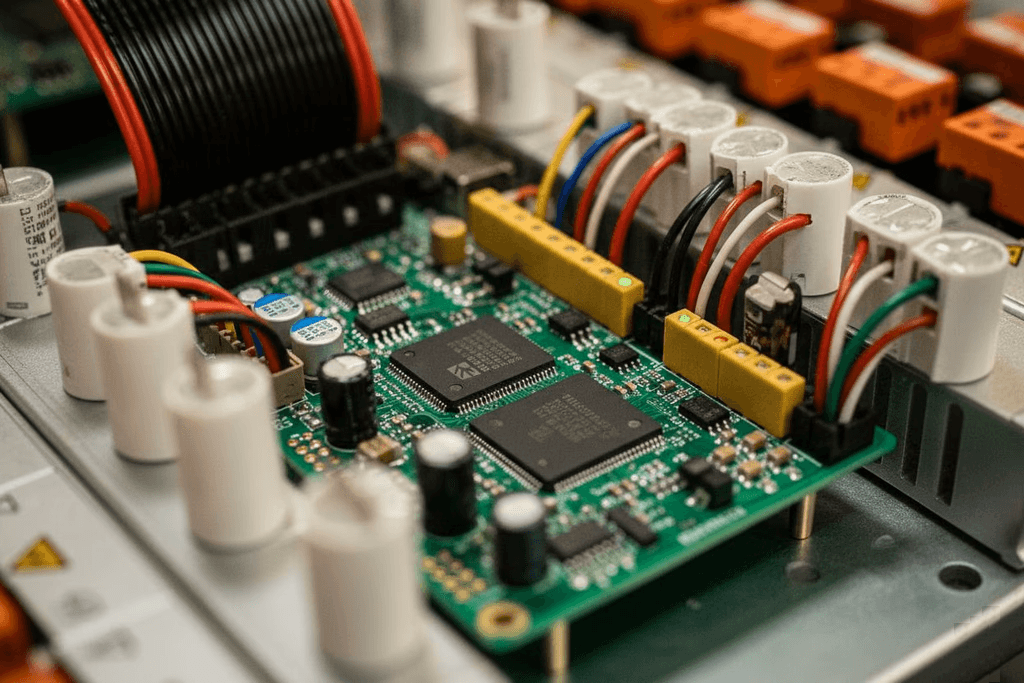
- Capacitors, cooling fans and contactors wear in service in a way the power semiconductors do not. Cooling is a designed-in service item: the LEON-A uses fan forced cooling and covers ventilation failure with dual fans and a fan failure alarm. Consumables replaced on schedule are normal ownership; consumables causing callouts are not.
- The batteries are due at the same time
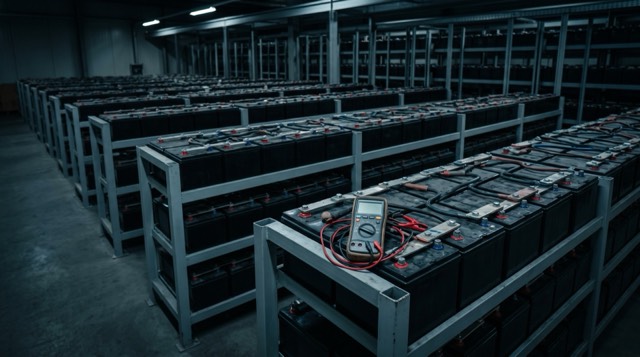
- Published design life is chemistry-dependent — 10 to 12 years for VRLA, 15 for OPzV, more than 15 for OPzS, more than 20 for Ni-Cd — so a string commissioned with the UPS reaches end of life near the electronics. One project rather than two shares the access route, change window and waste collection. Check the signals that a battery string is near end of life before assuming the string carries over.
- The alarm history no longer clears
- Read the event log, not the front panel. Alarms acknowledged rather than resolved — over temperature, charger failure, DC earth fault, load on battery — point either at the unit or at the installation around it, and separating the two is the work. An ambient-temperature alarm is not an argument for replacement; a standing fault nobody can clear is.
- The load no longer matches the machine
- Most often missed, because nothing is broken. Loads drift: circuits added, plant decommissioned, a floor changing use. A unit habitually near the top of its published overload envelope — the LEON-A is rated at 110% load continuous, 110-125% for 10mins, 125-150% for 1min — has no headroom for inrush; one at a fraction of its rating pays fixed losses to protect very little. Either way it is wrongly sized, so size the replacement from a measured load inventory, not from the nameplate you are removing.
Repair, refurbish or replace: judging it honestly
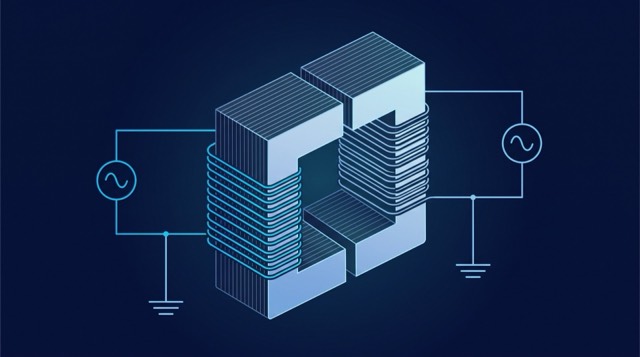
Not every ageing UPS should be replaced. Some units are recoverable, and repair and refurbishment deserve to be quoted alongside replacement rather than after it — in a transformer-based design the enclosure and galvanic isolation transformer are the longest-lived parts.
Three questions settle most of the argument. Does the fault sit in a renewable subsystem — cooling, capacitors, controls, contactors — or in the platform itself? Would a repair leave the same end-of-life date, the same spares problem and the same size mismatch? And is the unit still the right topology and rating for the load it serves today, rather than the load it was bought for? A repair that answers the first well and the others badly buys time at full cost. Make the comparison against a current quotation for the specific unit and a written view of what support remains.
Like-for-like UPS retrofit, or an architecture change?
A retrofit is the one realistic opportunity to change architecture: the room is open, the switchgear is being worked on, and an outage window is already negotiated. Decide before the specification is issued, though — an architecture change discovered during installation becomes a change to switchgear, protection and monitoring at the worst possible moment.
- Like-for-like
- Same topology, comparable rating, similar footprint. Lowest engineering risk, and the best chance of reusing the existing cable entries, battery bus and board — but it also reproduces whatever was wrong with the original design.
- Parallel units for redundancy or capacity
- Where the platform supports it, several smaller units replace one large one. The LEON-A Series can be operated up to 4 units in parallel, dual redundant or for added capacity, which turns a monolithic frame into an installation maintainable a unit at a time.
- A modular platform
- Modules are replaced while the system runs, and modular hot-swap UPS systems scale from 10kW to 3.6MW in Cumulus Power and 10kW to 3.75MW in Stratus Power, which publishes a power footprint of 1MW per square metre — often what lets a retrofit fit a room laid out for older equipment. Read what a modular architecture buys against a monolithic one first: it changes the repair model, not every single point of failure.
Survey the installation before you specify the UPS replacement
Almost every retrofit that goes badly was specified from a drawing rather than a survey, and the as-built rarely matches the room after years of small changes. Record what is actually installed — starting with the load, measured over a representative period rather than added up off equipment labels — then have the calculations and drawings produced from that record.
- The electrical arrangement: phase configuration in and out (the LEON-A is built in 1:1 Phase, 3:1 Phase and 3:3 Phase models) and wiring — 3W (P+N+PE) single-phase, 5W (3P+N+PE) three-phase. Mains voltage range is ±10% as standard with ±15% and ±20% optional, which matters on a generator-fed supply.
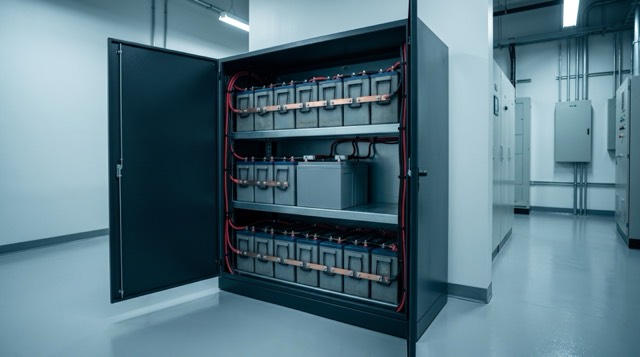
- The battery. Bus voltage and chemistry decide whether this is one project or two: the LEON-A works at 110VDC, 220VDC or 384VDC with VRLA, OPzV, OPzS, NiCad and AGM strings. If the new unit's DC bus does not match the installed string, the string is in scope.
- The environment, measured at the equipment: operating temperature -10 to 50°C, rated altitude 1000m from MSL with a 1% derate each 100m above, IP20 as standard and up to IP55 optional.
- Monitoring, and the switchgear either side. Standard provision on the LEON-A is ModBus RTU RS232 with Dry Contact x4, extendable to x16, plus RS485, ModBus TCP/IP, SNMP and IEC61850 optional. Establish too what feeds the UPS, what it feeds, and whether the bypass lives in the unit or the board — that determines the changeover options.
The physical realities that sink a UPS retrofit
The specification gets the attention. What actually stops the job is geometry and mass.
The outgoing unit has to leave by a route it may never have used — plant is often installed before the walls are finished. Measure the whole path: door and corridor widths, the turning radius at the tight corner, lift car dimensions and rated capacity, thresholds and ramps. Floor loading is the item that cannot be improvised, particularly over a raised floor and under a battery stand.
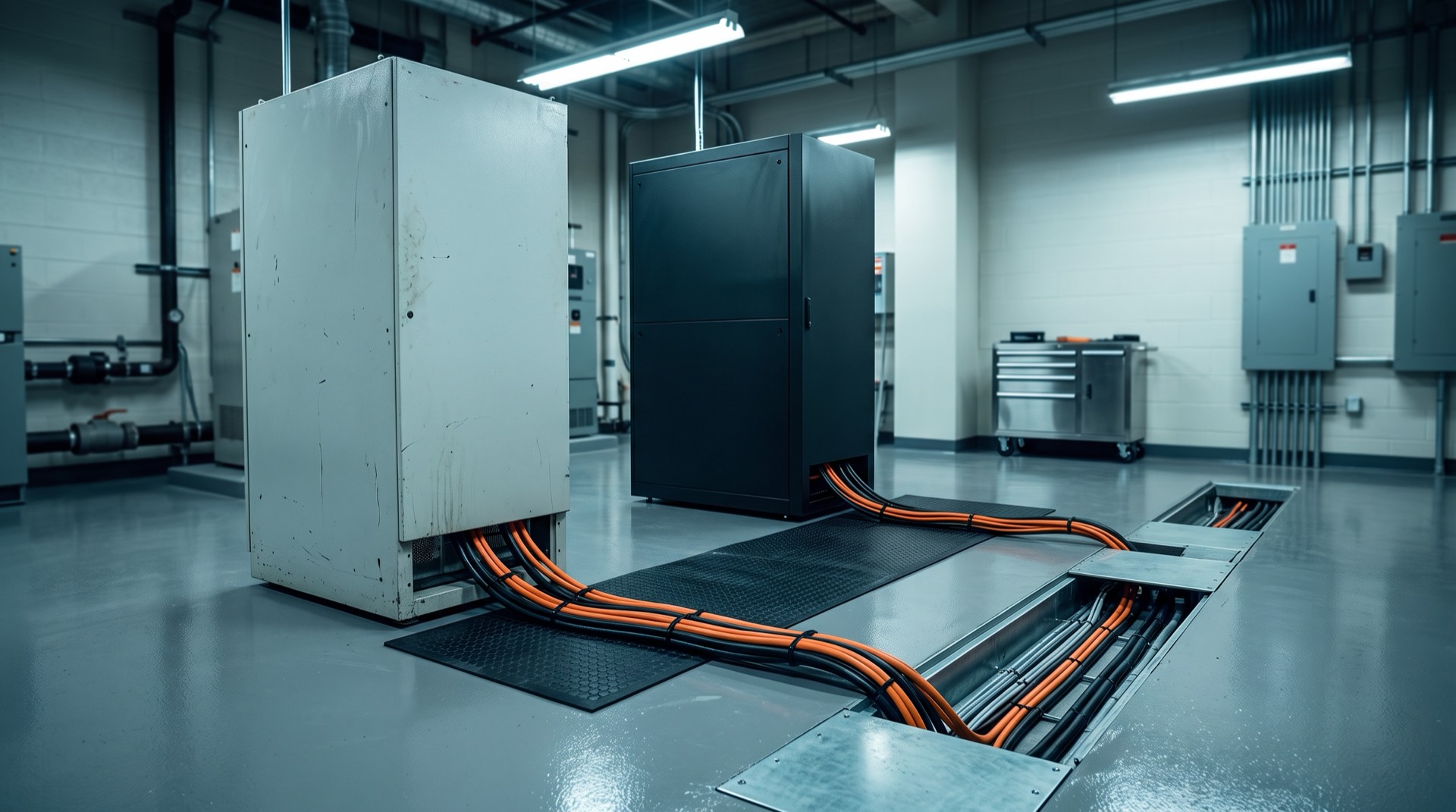
Then the position of things. Cable entry on the LEON-A is from the bottom as standard with other arrangements optional, and a smaller footprint is no help if the entry sits on the wrong side of the existing trench or floor void. Service clearance is the same trap in reverse: full front access only pays back if the space in front of the cabinet stays clear. Confirm all of it against the drawings for the unit offered, and on site.
Keeping the load powered during the changeover
There are three broad ways to hold the load while the old unit comes out, differing mainly in how much risk stays open and for how long. What follows describes them; it is not a method. The sequence belongs to the manual for each unit involved and to a competent person who has surveyed the installation and written a method statement — working near an energised board and a charged battery string is dangerous, and the switching order is equipment-specific.
One decision deserves to be made in the open: whether the load will run unprotected for a period, and for how long. Often the answer is yes because it is the least disruptive option — legitimate, provided somebody owns it. Write down which loads are exposed, what happens if the mains fails while the window is open, and who is authorised to stop work; then have it approved by whoever approved the capital. An exposure nobody wrote down turns a planned upgrade into an incident report.
- On the outgoing unit's maintenance bypass
- The load runs on raw mains through the existing bypass path. A maintenance bypass exists so a UPS can be serviced without interrupting the load — the LEON-A includes one — but while it carries the load there is neither conditioning nor stored energy behind it. A maintenance feature, not protection.
- On a redundant path
- Parallel and modular installations, and dual-path distribution, carry the load on one path while the other is worked on — or move it across in groups so no single step exposes everything. The lowest-risk option, and the reason many operators use a retrofit to create redundancy the site never had.
- On a temporary supply
- A hired UPS, a temporary board or a generator-backed feed. It converts one long exposure into two short ones at the transfer points, and adds its own scope: space, cabling, protection, fuel, and its own single points of failure.
Handover: as-built records, commissioning data and disposal
The job is not finished when the load is back on the inverter. What you keep decides whether the next decision starts from evidence or from another survey of unknowns — and the battery records matter most, because they get trended. A new baseline is what makes routine battery inspection, monitoring and capacity testing mean anything later.
- As-built records and commissioning results, written down: updated single-line diagram, cable schedules, the settings left in the unit, firmware revisions, changes made in the boards either side, and the acceptance tests including behaviour on transfer and on loss of mains.
- A fresh battery baseline. New string or carried over, record per-block ohmic readings, an acceptance discharge and the temperature at the battery, so future trending has a starting point.
- Alarm points proved end to end, and the recommended spares confirmed in writing for the unit you bought — availability is a moving figure, so take it from the supplier when you plan.
- Disposal as regulated waste. The old UPS and its batteries leave site by the route appropriate to their chemistry, with the documentation it requires. The rules differ by jurisdiction, so confirm them with your waste contractor, treat collection as project scope, and keep removed blocks upright and protected against short circuits.
Turning a UPS replacement into a case that gets approved
A capital request survives review when it is built from evidence rather than age: the load and autonomy the site needs, the signals that the installed system no longer delivers them dependably, what repair would and would not fix, and the difference between doing the work on your schedule and on the equipment's.
If you are at that point, talk to our engineering team about your installation. Tell us what is installed and what it feeds, the phase and voltage arrangement, the battery bus and chemistry, the access route into the room, and how much of a change window you can offer — we will come back with a like-for-like or upgraded option, the calculations and drawings to support it, and current availability to plan the dates against.