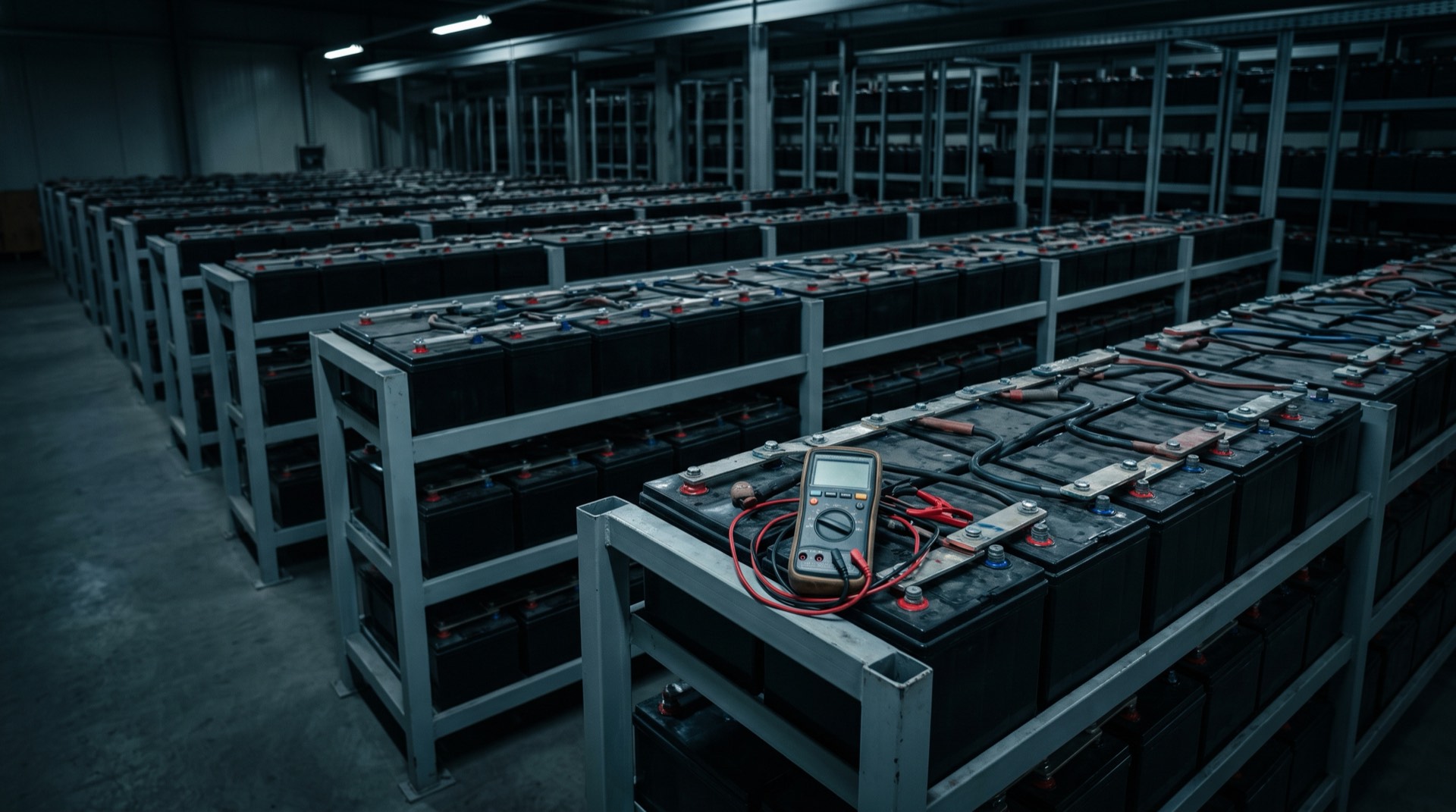
Why the battery decides whether a UPS rides through
That invisible decline produces a specific failure mode. The UPS does not fail to transfer; it transfers correctly, holds the load for a fraction of the autonomy the design assumed, then drops it — during the one event it was bought to cover.
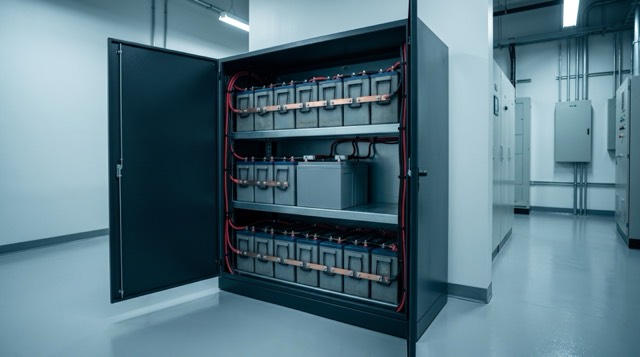
Because the blocks sit in series, a string also delivers only what its weakest member delivers: one degraded block limits every healthy block around it, and a block that fails open leaves the UPS with no battery at all. Ageing is continuous rather than event-driven, which is why the regime is a schedule rather than a response — and why the measurements worth having are per block, not per string.
What a routine UPS battery maintenance inspection checks
Most battery failures leave visible or thermal evidence before they become electrical events, which makes the cheapest part of the regime one of the most productive. What counts as acceptable for each item comes from the battery manufacturer’s documentation and the commissioning record for that installation: an article can give the list, never the limits.
- Case condition on every block: distortion, bulging, cracking, discolouration — signs of internal pressure or heat.
- Leakage or tracking around posts, seals and vents; on flooded types, level against the marked limits.
- Terminals and inter-cell links for corrosion, oxide film and looseness, retightened only to the manufacturer’s torque figure with a calibrated tool — and joint temperature, since a poor interface runs hotter than its neighbours.
- Cleanliness, since damp dust on case tops conducts between posts, plus the rack’s corrosion, restraint and bracing.
- Ambient temperature at the string, not off the thermostat; ventilation paths clear; event-log alarms investigated rather than acknowledged.
Temperature and ventilation: the environment does the ageing
Temperature is the dominant factor in how fast a lead-acid battery ages, so the string’s environment is what a regime should control first. Heat accelerates the chemistry that consumes the plates and, in a valve-regulated cell, drives out water that cannot be replaced. Cold instead cuts the capacity available on the day without permanent harm: a hot room costs service life, a cold one costs runtime.
So temperature is a logged measurement, not a comfort setting — taken at the string, checked for a gradient up a tall rack, and kept clear of the UPS’s own exhaust air. Confirm the charger’s temperature-compensation probe sits where the specification puts it: one reading room air will confidently apply the wrong correction all year. Ventilation matters separately: charging produces hydrogen, vented cells far more of it, and while the air a room needs is a design calculation, maintenance can prove what was specified still works. At power plants and industrial zones, dust and vibration make a silted filter both problems at once.
Instrumented monitoring: why trending beats a single reading
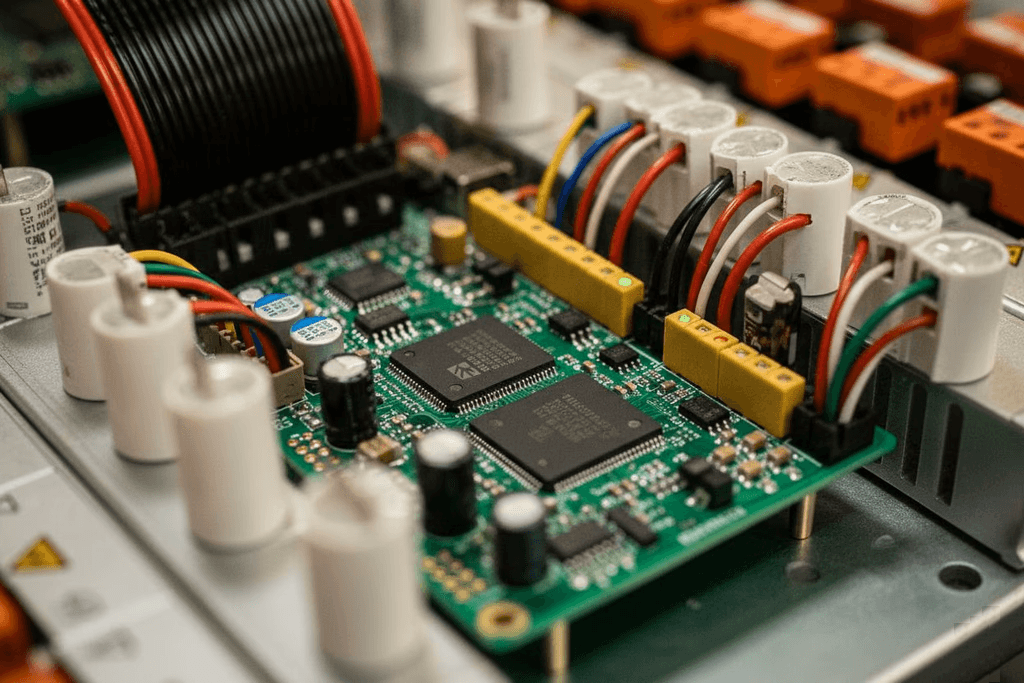
Beyond the inspection sit instrumented measurements: block voltage on float and under load, an internal ohmic measurement (impedance, resistance or conductance, depending on the instrument), inter-cell connection resistance, temperature per block, and on flooded cells gravity and level.
A single absolute value from any of them tells you little. Ohmic readings depend on chemistry, model, batch, state of charge, temperature and the instrument’s own method, so two instruments can read the same healthy block and disagree. What carries information is comparison: each block against the others read the same day, and each block against its own history. A block drifting while its neighbours hold steady deserves attention even inside limits; a whole string drifting together points at the charger, temperature or duty.
Trending therefore needs a baseline captured at commissioning and a consistent method — same instrument, same leads, same points, comparable conditions — because changing instrument resets the trend. Whether a drifting block is one to watch or one to investigate is decided by the manufacturer’s figures for that model and the commissioning data for that string.
Battery testing: a UPS self-test is not a capacity test
Nearly every UPS runs a battery test of its own — a brief transfer, a short discharge, or a load step with the response measured. It is automatic and worth having: it confirms the string is connected, the fuse intact, no block open circuit, and terminal voltage not collapsing when load appears. That catches the most embarrassing failure in the building: a UPS with no usable battery behind it.
What it cannot do is prove the string will carry the real load for the required autonomy. A brief test exercises only the beginning of the discharge curve, and runtime lives in everything after it; the remaining-runtime figure on the display is a model, calibrated when new. Only a capacity or discharge test — a defined current for a defined duration, with per-block voltages logged throughout — measures what the design depends on.
So the self-test is an availability check, trending is early warning between visits, and only a capacity test proves performance: an autonomy figure is worth as much as the last test that confirmed it.
Running a discharge test without risking the live load
The test deliberately walks the battery towards the condition you are worried about, so the planning is the test. Decide first what it must prove — design autonomy at design load, or which blocks are weakest — since the setups and the criteria differ, and the criteria come from the battery manufacturer’s documentation and the UPS commissioning data for that site. A short result is a planning input, not an emergency; what follows is covered in when to replace UPS batteries.
- Discharge into a load bank rather than the live load wherever topology allows: a defined, repeatable current, with the critical load on another source.
- Prove the fallback first — bypass, a second module, generator, alternate feed — by inspection rather than from a drawing.
- Recharge fully and let the string settle first, or the test measures the recharge, not the battery.
- Log per-block voltages the whole way through with ambient temperature and current: a string can meet its duration while one block has reversed.
- Treat the string as vulnerable afterwards; insulated tools, correct PPE, a written switching sequence and a second person throughout.
How maintenance differs by battery chemistry
Chemistry changes what the regime must do, and a procedure written for one type can be actively wrong on another. Whichever of the four types in the industrial battery range is installed, the intervals and criteria are those in the battery manufacturer’s documentation for that exact model.
- VRLA and AGM
- Valve-regulated: maintenance-free describes the electrolyte and nothing else. With nothing to top up and no gravity to read, the warning picture rests on visual condition, temperature, connections and trending — and heat is unforgiving, since water lost through the valve never returns.
- OPzS, vented flooded cells
- Flooded cells in translucent containers tell you more than a sealed type: plates and level are visible and gravity can be read cell by cell, paid for in service work — scheduled topping up with water of the specified quality, and a room built for the gassing.
- OPzV, gel and valve-regulated
- Immobilised gel electrolyte on tubular plates: no topping up and far less gassing, but the cell hides its condition, so temperature control and trending replace the hydrometer.
- Nickel-cadmium
- Tolerates temperature extremes, deep discharge and mechanical abuse far better than lead-acid, so it appears where the environment is part of the problem. Little transfers from lead-acid practice, though: the charging regime differs, and a lead-acid ohmic instrument may say nothing useful here.
What to expect from a UPS maintenance contract, and what records to keep
Most sites buy this work rather than staff it, and what arrives varies enormously — usually because the scope never said which of these activities was included. ENCLOVE provides scheduled and emergency maintenance for the systems we supply; if an installation has no defined regime, talk to our engineering team with the battery model and whatever commissioning data exists.
- Which visits are inspection-only and which include instrumented per-block measurement — and do you get the data or a verdict? Dated per-block figures naming the instrument, or it is not an asset record.
- Is a capacity test in scope at all — at what interval, into a load bank or the live load, and who supplies the bank?
- Is the rest of the chain reviewed: charger settings, alarms, the runtime model, and whether design autonomy still matches the connected load?
- The commissioning record
- Configuration as installed, block identifiers and positions, baseline measurements, charger settings as commissioned, and the autonomy the site was signed off against.
- A dated per-block log
- Every reading with its instrument and ambient conditions, the discharge log behind each capacity test, and a change log of blocks replaced or settings altered.