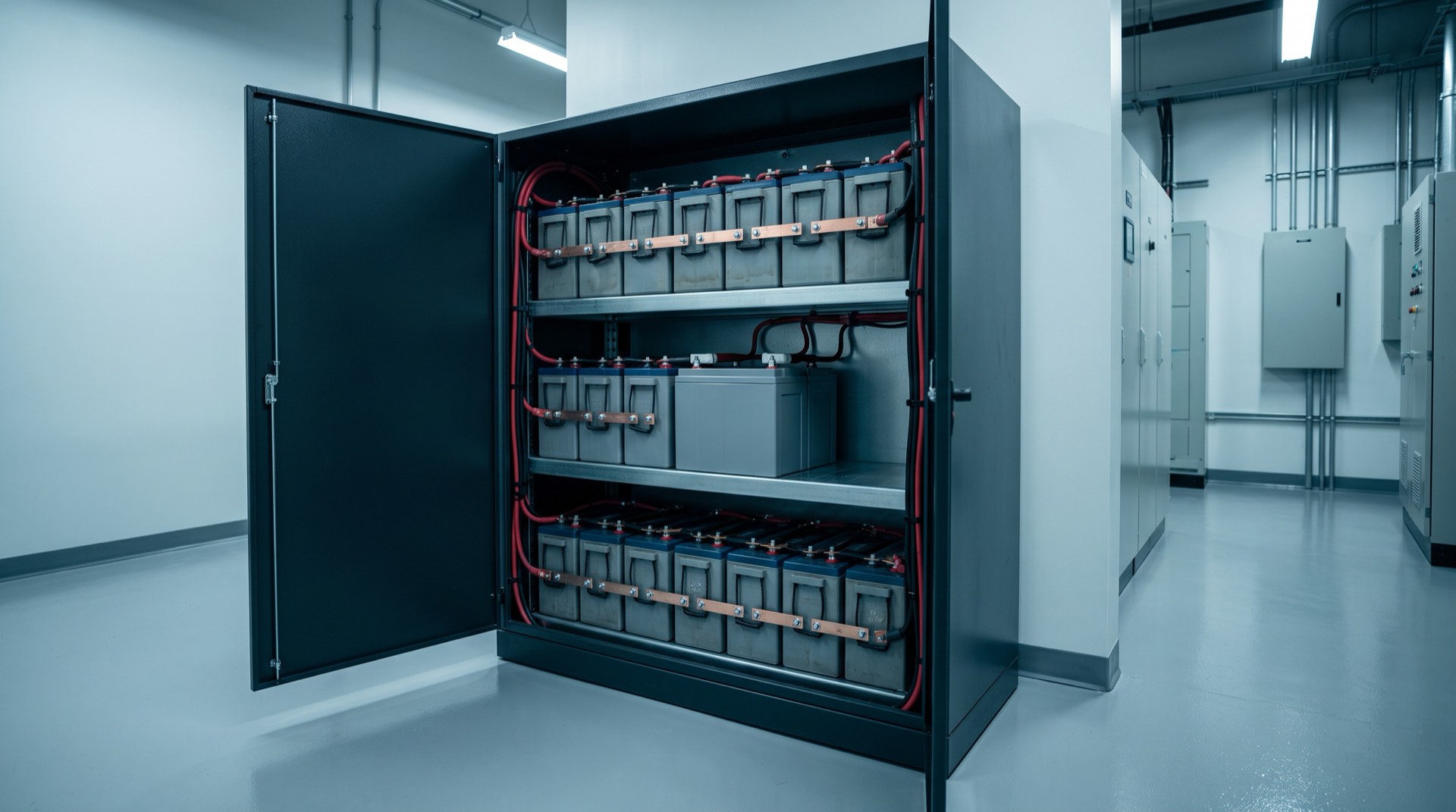
When to replace UPS batteries: why there is no universal date
A manufacturer's design life is a statement about conditions, not an entry in your calendar: it assumes a reference ambient temperature, a defined float regime and a certain duty of discharges. Two identical strings — one in a conditioned electrical room, one beside a transformer in a plant room — will not reach end of life together. Design life is a budgeting input, not a service interval.
The figures that govern the decision are site-specific: the capacity below which the string no longer meets the autonomy your load requires, the ohmic deviation that counts as a flag, the pass criteria for a discharge test. They come from exactly two places: the battery manufacturer's documentation for the cells or blocks you actually bought, and the commissioning baseline recorded for that string when new. A threshold quoted without reference to one of those is a rumour. If no commissioning data exists, closing that gap is the first job — every signal below is a trend, and a trend needs a starting point.
The warning signs that a UPS battery string is near end of life
No single reading condemns a string. A defensible case is built from several independent signals moving the same way across successive service visits — with alarms and lengthening recharge times in the operations log as prompts to measure.
- Measured autonomy is shrinking against the baseline
- A discharge under a known load is the only direct measurement of what the string will do in an outage. Compare each result with commissioning, at the same load and end-voltage criterion. One result is a data point; the slope across several is the decision — and expect it to steepen, because capacity fade is not linear near end of life.
- Impedance or conductance is trending upward
- Ohmic testing is fast, non-invasive and done in service, which makes it the workhorse trending measurement. It is comparative, not absolute: meaningful against the same block measured before with the same instrument, and against its neighbours. Watch direction and spread — blocks tightly clustered at commissioning that now scatter say something before any crosses the manufacturer's published limit.
- Physical symptoms you can see, feel and smell
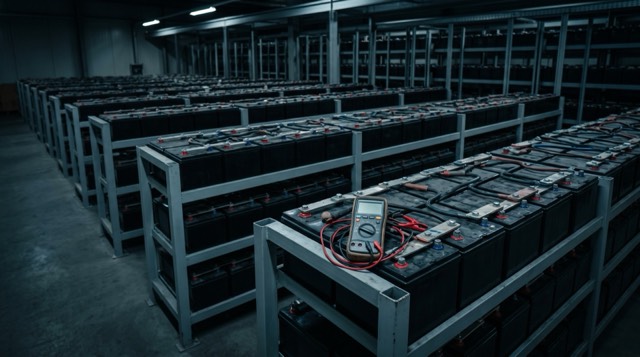
- Case swelling on valve-regulated blocks, corrosion or salting at the posts, distorted terminals, weeping around seals, an acrid smell in the cabinet, or one block warm in an otherwise even row. Investigate these rather than schedule them: a swollen block has lost pressure control and is on a shorter clock than the rest of its string. A thermal survey of the row is among the cheapest checks available.
- Block replacements are becoming more frequent
- One failure early in life is infant mortality. Several later failures, in different positions in the string, are the population failing rather than bad luck. When the interval between replacements shortens the programme has already begun; the only question is whether you keep running it one block at a time.
Why a passed UPS self-test is not proof the batteries are good
Owners are most often surprised because a self-test was mistaken for a capacity test. A self-test is brief and lightly loaded; depending on the product it may confirm little more than that the string is connected, that its voltage does not collapse at transfer, and that the inverter can be fed from DC. That is a function check, not a measurement of stored energy.
Two traps follow. A short, shallow discharge is easiest to pass exactly when the plates are most degraded — initial voltage under load looks acceptable while the knee in the curve arrives far earlier than the runtime you are counting on. And a series string delivers only what its worst block allows, which a single aggregated pass or fail cannot see. A pass means the string is present and not yet dead. How long it will actually hold the load is answered by routine UPS battery inspection, monitoring and capacity testing; never let a green indicator postpone a replacement the trend already supports.
How ambient temperature moves the replacement date forward
Temperature most often explains a string reaching end of life earlier than the budget assumed. Heat accelerates the internal processes that consume a battery's life, and the effect is cumulative and irreversible: a string does not recover the life it spent through a hot summer once the room cools. How much life a given temperature costs depends on chemistry and construction and is published by the battery manufacturer for that product — do not apply a remembered rule of thumb to a capital decision.
What you can act on is measurement, taken at the battery rather than the thermostat or the UPS air intake. Look for the hot end of a rack, the top tier of a stand, and cabinets sharing a room with a transformer or the UPS's own exhaust. Uneven temperature within one string is worse than a uniformly warm room: it de-synchronises ageing, and usable capacity follows the weakest blocks. In datacenter and telecom power systems the battery room is normally conditioned and monitored, so design-life assumptions hold up; in a plant room, a marine compartment or an outdoor enclosure they are optimistic until measurement says otherwise — plan the shorter cycle and budget for it.
Planned versus emergency UPS battery replacement
The batteries are the visible cost, and the one that varies least. What separates a planned replacement from an emergency one is everything around them.
- Access, labour and freight. Blocks are heavy, they arrive on pallets, and battery rooms are sized for the equipment rather than its removal. A planned job books the route, the lift, the handling aids and the collection in normal hours; an emergency job pays for out-of-hours attendance, expedited shipping and a return visit for parts that did not fit.
- The outage window. During the swap the load sits on bypass, on a temporary supply, or on a redundant path. A window agreed ahead at low load is a wholly different risk from one forced at short notice by a failed string.
- Procurement position. Buying under pressure narrows the choice to whatever can ship, which may not be the right construction, terminal arrangement or footprint for the existing stand.
- Consequential risk. Between the day a string can no longer hold the load and the day it is replaced, the UPS is a conditioner, not a source of backup. Every disturbance in that window is an unprotected event, priced by the value of the load.
Should you replace the whole string or just the weak blocks?
The instinct on finding one bad block in an aged string is to change it and move on. It is quick, cheap and usually the wrong answer. A series string shares one charge current, so the new block joins a population with different internal resistance and charge acceptance, on a float regime tuned for the blocks already there. Capacity is not restored — the string still delivers only what its remaining weak blocks allow — while the new block spends its life in unfavourable company. The next failure typically arrives sooner than the last.
- When partial replacement is defensible
- Early in life, when the rest of the population still measures close to baseline, a failed block is an infant-mortality or warranty case, and a like-for-like swap is reasonable. As a bridge to an already-approved replacement date it is a considered risk, not a repair — give it an end date so it does not quietly become the strategy. And where a string is built from large single cells, individual replacement is a more normal part of the regime than in a rack of monoblocks; follow the manufacturer's guidance on matching.
- Keep it like-for-like, and write it down
- Same manufacturer, same type and rating, same construction, connectors that suit the existing arrangement — then record what changed and when. A string with an undocumented mixed population is one nobody can trend later, which is how an installation slides back into reactive replacement.
Planning a UPS battery replacement: lead times, load protection and disposal
The schedule is built backwards from three things: when the batteries can arrive, when the load can be exposed, and who takes the old ones away.
- Confirm the lead time with your supplier before committing to a date. Availability moves with chemistry, capacity, construction and destination, so ask for a current figure for the exact product and quantity — not a remembered one.
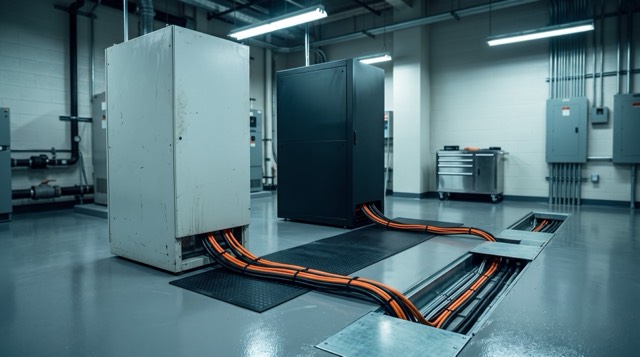
- Decide how the load stays protected: a maintenance bypass with the load on raw mains, a temporary string for the duration, or a redundant path where modular UPS systems and parallel architectures let one unit run battery-off while another carries the load. Each needs a method statement covering a mains failure mid-swap.
- Settle the physical detail in advance — weight per block and pallet, floor loading, delivery and removal routes, inter-tier links and connectors, the manufacturer's torque values, insulated tooling and the right PPE.
- Re-baseline on commissioning. Record the acceptance discharge, the per-block ohmic readings and the temperature at the battery, and file them so the next decision starts from evidence.
- Treat the old batteries as regulated waste. Lead-acid and nickel-cadmium batteries leave site through the appropriate route for their chemistry with the paperwork that route requires, and the rules differ by jurisdiction — confirm them with your waste contractor. Book the collection as part of the job, keep removed blocks upright and protected against short circuits, and never let a pallet of end-of-life batteries become storage in an electrical room.
Turning the warning signs into a replacement plan
A defensible decision is not one measurement; it is a short standing argument you can put in front of whoever approves the spend. It has four parts: the autonomy the load genuinely requires, the evidence that the string does or does not still deliver it, the trend that says how long that stays true, and the cost difference between doing the work on your schedule and on the equipment's. Written down, it survives a finance review, which "the batteries feel old" does not.
If your trend is pointing the wrong way, or you have inherited an installation with no baseline to trend against, talk to our engineering team about a replacement plan. Tell us which UPS or rectifier the string serves, the autonomy the load needs, the chemistry installed and the environment it sits in, and we will come back with a like-for-like or upgraded option from our industrial battery range, with current availability to plan against.